
By Elizabeth Kivuva, Abojani Research on H1 2026 Economic
1. Kenya’s Banking Recovery: Strong H1, But Can It Pull Through Into H2?
Kenya’s banking sector delivered a broad earnings recovery in H1 2026, supported by a more favourable monetary environment than a year earlier. However, the recovery was uneven, with performance reflecting differences in lending growth, funding costs, non-interest income, asset quality and regional diversification.
Banks that deployed their balance sheets more aggressively and diversified income beyond lending captured more of the upside, while more conservative, liquidity-heavy institutions saw earnings growth stall or reverse.
The improvement came as the Central Bank Rate (CBR) fell to 8.75% in February 2026 from 9.0% and remained unchanged through June and August. This continued the monetary-easing cycle that began in 2024, with the effects increasingly visible in bank earnings.
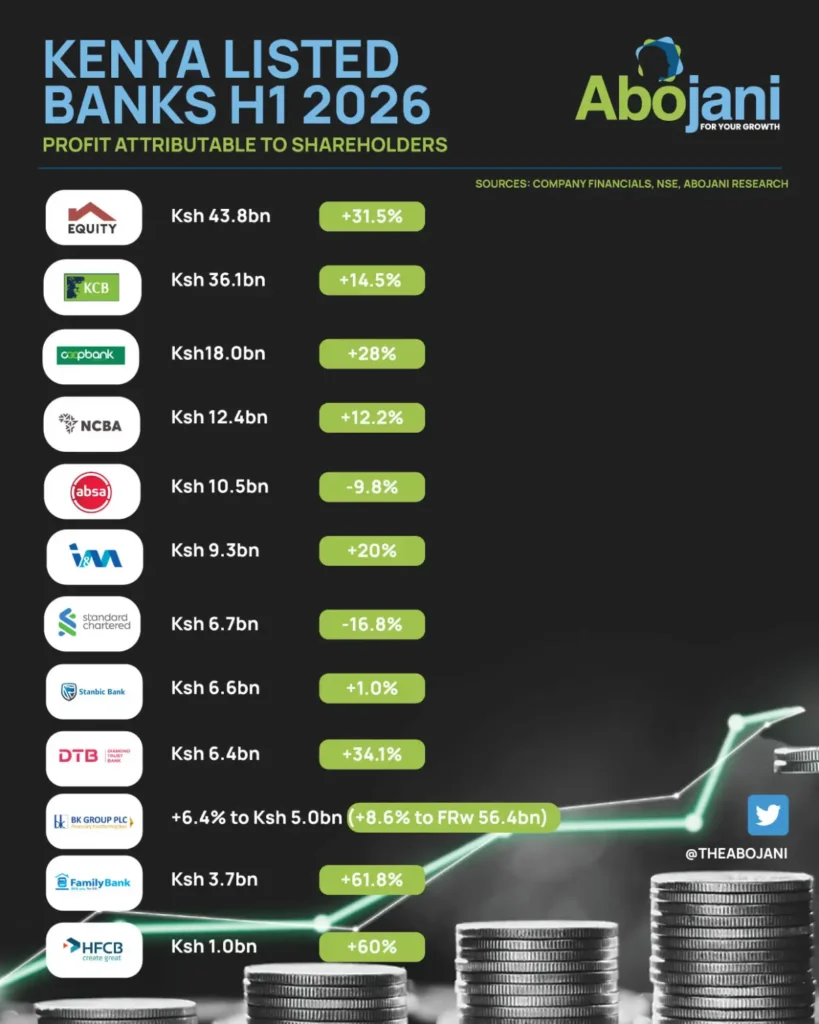
Among the major listed banks, Equity reported KSh43.8 billion in profit, up 31.5%; KCB reported KSh36.1 billion, up 14.5%; Co-operative Bank KSh18.0 billion, up 28%; NCBA KSh12.4 billion, up 12.2%; I&M KSh9.3 billion, up 20%; and DTB KSh6.4 billion, up 34.1%. Stanbic grew profit by 1%, while Absa and Standard Chartered recorded declines of 9.8% and 16.8%, respectively.
Equity was particularly notable. Its 31.5% earnings growth came from an already large base, with regional profit before tax growing 42% to KSh26.2 billion, compared with 35% growth in Kenya to KSh29.4 billion.
At sector level, profit before tax increased from KSh83.5 billion in Q1 to KSh88.9 billion in Q2, while return on equity rose from 23.0% to 24.1%.
The question, however, is whether this recovery can continue.
Also read: Equity Group Holdings & KCB Group Dominate Kenya’s H1 2026 Banking Results
2. The Economy Is Recovering, But Inflation Is Re-emerging
The broader economy entered H1 on firmer footing. Real GDP grew 5.3% in Q1 2026, up from 4.9% a year earlier, with financial and insurance activity growing 6.3%, manufacturing 4.4%, construction 6.6% and agriculture 4.9%.
Financial conditions also eased. The CBR stood at 8.75%, Kenya Shilling Overnight Interbank Average (KESONIA), was around 8.75%, and the 91-day Treasury bill yield was approximately 8.77%. Lending rates declined to 14.39% in July, while the average deposit rate stood at 6.93%.
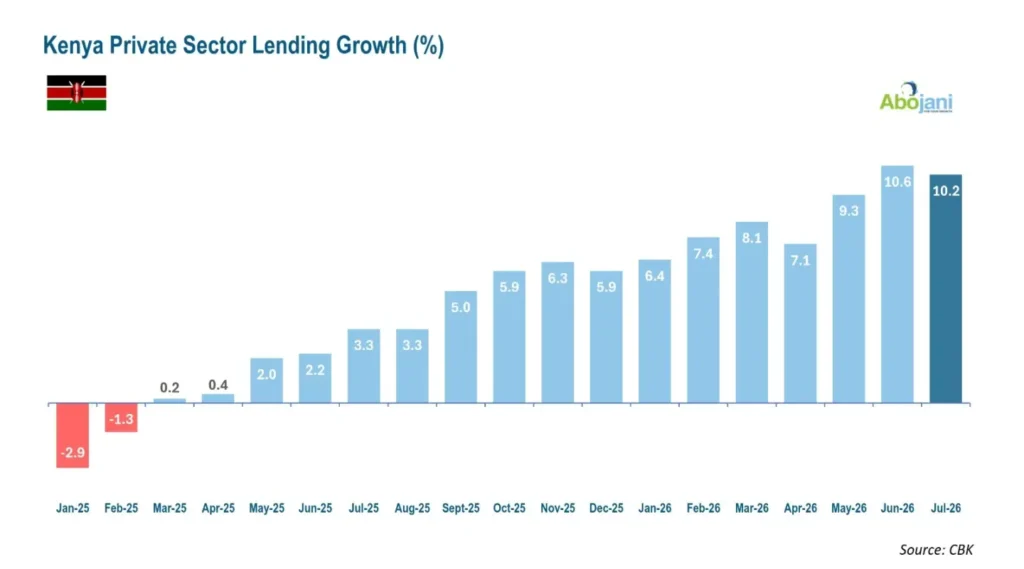
Lower borrowing costs should support credit demand, investment and economic activity, creating a more favourable environment for banks as loan growth recovers.
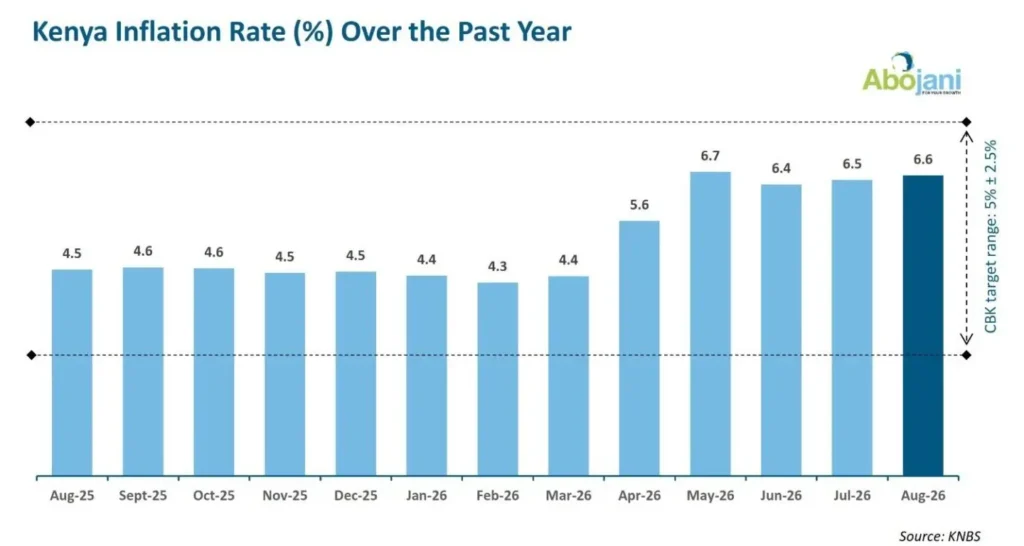
However, inflation has become a more important constraint. Headline inflation rose from 4.5% in August 2025 to 6.6% in August 2026, with food inflation at 9.0% and transport inflation at 15.7%.
Producer inflation remained relatively contained at 1.43% in June 2026, although the Producer Price Index increased 4.47% quarter-on-quarter. This suggests that the pressure is currently being felt more strongly by consumers through food and transport costs than through a broad-based producer-price shock.
The Purchasing Managers Index (PMI) also points to a more complicated recovery. After rising above the 50-point expansion threshold to 51.3 in July, it fell to 49.7 in August. Firms cited inflation, liquidity constraints and material shortages, while input purchases declined for a fourth consecutive month.
This creates a more difficult backdrop for monetary policy. The H1 earnings recovery benefited from lower rates, but inflation may limit how much further easing can continue. This is important for banks because the H1 earnings improvement was supported by the easing cycle. If rates remain accommodative, the benefits could continue to pull through into H2; if inflation constrains further easing or deteriorates until a hiking cycle is reinstated, the earnings recovery will have to rely more heavily on actual credit growth, efficiency and diversified income.
3. H1 Recovery or H1 Pull-Forward?
Three forces now matter most for H2.
- First, monetary conditions have eased. Lower rates have reduced borrowing costs and improved the environment for private-sector credit.
- Second, economic growth has strengthened, giving businesses and consumers more room to borrow, invest and spend.
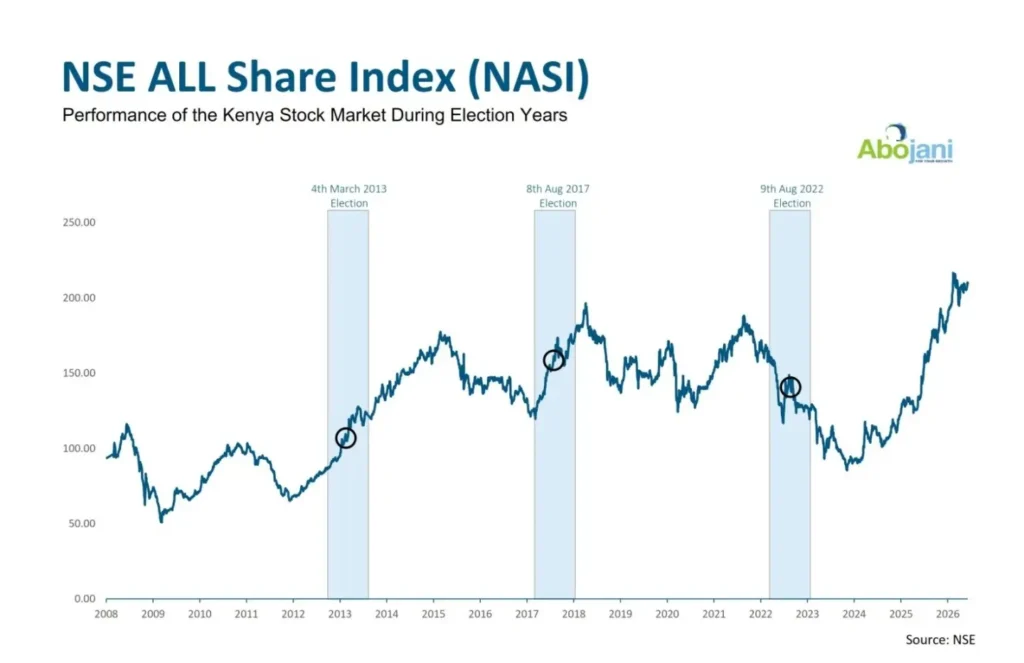
- Third, markets have already begun pricing in the recovery. The NSE has rallied strongly, with Safaricom up 33% year-to-date as of September 4, Equity up 57% and KCB up 49%. At the same time, foreign investors sold KSh4.55 billion of equities in August, while local institutional investors increased their equity exposure.
Pension funds increased listed-equity holdings by KSh13.51 billion in H1 while reducing government-security exposure by KSh35.14 billion. This suggests that domestic institutional investors are increasingly rotating toward equities as bond yields decline.
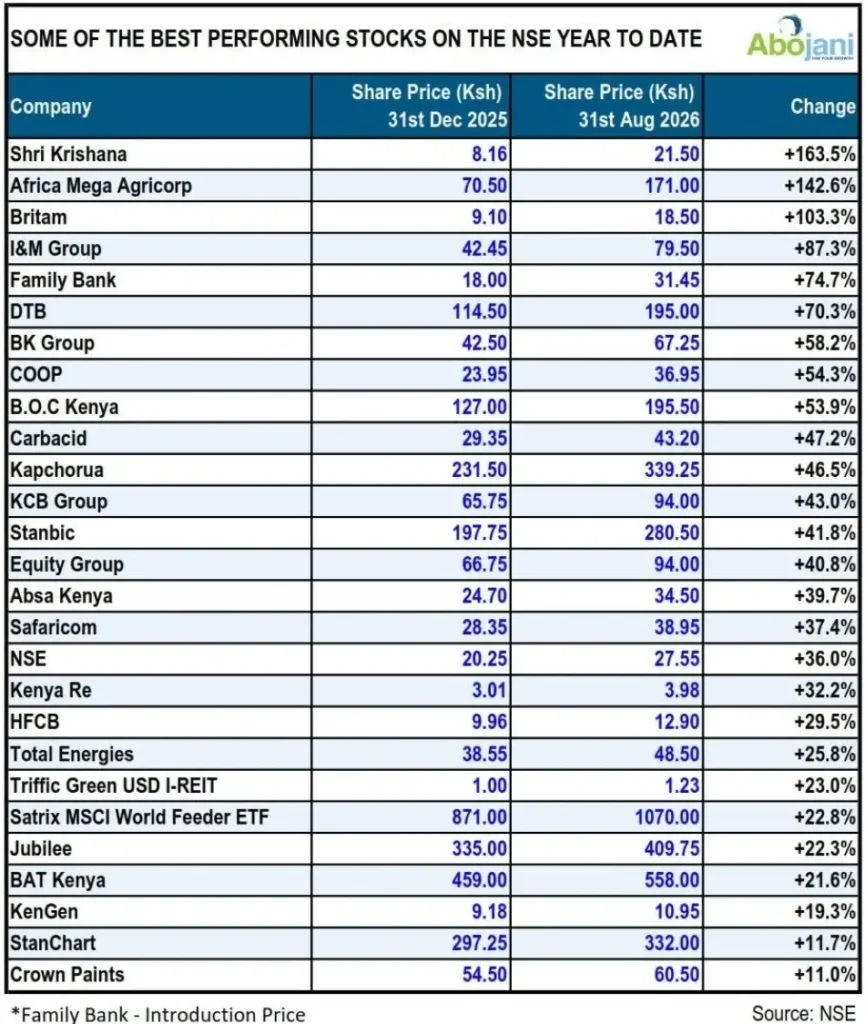
The implication is important: the market is no longer waiting for the recovery to become visible. It has already started anticipating it.
There is also a risk that some economic activity was brought forward ahead of the 2027 general election. H1 earnings may therefore capture not only the benefits of monetary easing, but some activity that might otherwise have occurred later.
This creates the central H2 question: will the H1 pull-forward become an H2 pull-through? For that to happen, lower financing costs must continue translating into stronger private-sector credit growth, investment, consumption and business activity. Otherwise, the initial earnings boost could fade.
4. What It Means for Investors
Banks and Equities: Recovery, but Selectivity Matters
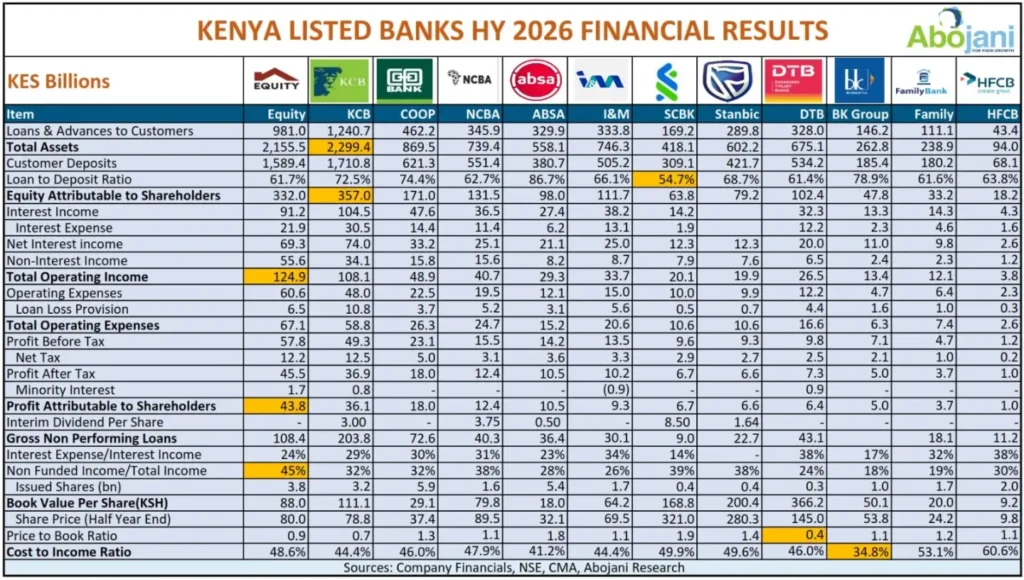
The H1 results favour banks with strong deposit franchises, diversified income streams, improving asset quality, the capacity to grow loans without significantly increasing credit risk, regional diversification, digital capabilities and reasonable valuations.
- Equity stands out for its combination of earnings growth, scale, non-funded income and regional diversification.
- KCB offers scale and valuation appeal, although its large absolute NPL stock remains a variable to monitor.
- Co-op’s strong earnings growth reflects greater balance-sheet deployment, creating more upside if credit growth accelerates, but also greater sensitivity to asset quality.
- Meanwhile, the weaker performance of Absa and Standard Chartered demonstrates that operational efficiency alone does not guarantee earnings growth in a changing rate environment.
Investors should therefore look beyond headline H1 profit growth and examine how much of the improvement came from sustainable loan growth, lower funding costs, fee income and stronger asset quality.
The falling-rate environment also changes the relative attractiveness of different asset classes. As government bond yields decline, the opportunity cost of holding equities falls. The movement of pension funds from government securities toward listed equities provides evidence of this portfolio reallocation.
However, investors should not chase the market indiscriminately. Rising share prices alongside foreign selling (KSh4.55 billion August outflow) suggests that some international investors are taking profits after the rally, even as domestic institutions continue accumulating.
The next stage of the market may therefore depend more heavily on earnings growth and domestic liquidity than on foreign inflows. Investors therefore need to distinguish between companies whose share prices have already fully reflected the recovery and those where earnings still have room to catch up.
Inflation changes the rate-cut thesis
With inflation at 6.6%, investors should not assume that the CBR will continue falling at the same pace seen during the 2024–2025 period. The CBK has kept the CBR at 8.75% since February, suggesting that policymakers are balancing growth support against inflation and external risks.
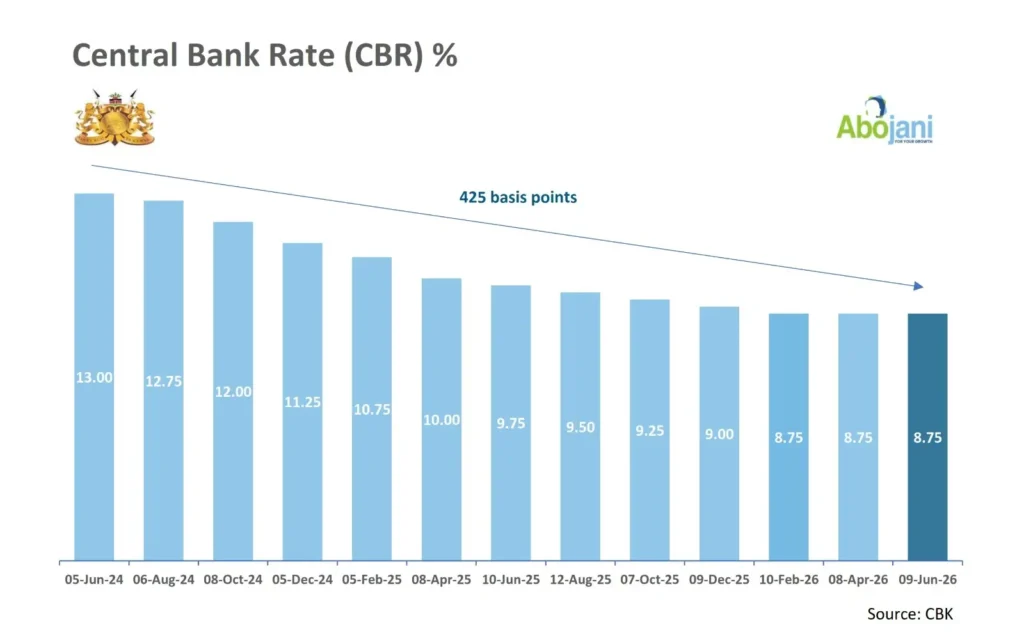
The investment implication is important: the strongest bull case is not necessarily one where rates fall sharply. It is one where rates remain relatively accommodative while economic growth and corporate earnings continue improving.
This is also where the distinction between pull-forward and pull-through becomes important. If the benefits of lower rates have largely been brought forward into H1, H2 could see slower earnings growth. But if lower rates continue to translate into stronger borrowing, investment and consumption, the initial boost could pull through into the second half of the year.
5. What to Watch in H2
The outlook for Kenyan equities will depend on how inflation, monetary policy, economic activity and corporate earnings interact.
In a bull case, inflation moderates, the shilling remains stable, PMI returns above 50 and GDP growth remains above 5%. This would support faster credit growth and continued strong bank earnings, provided NPLs remain contained.
In a base case, inflation remains within the 5–7% range, the CBR stays broadly stable and GDP growth holds around 5%. Banks would continue growing earnings, but at a slower pace as some benefits of monetary easing have already been captured in H1. The market would consequently become more selective and valuation-driven.
A bear case would emerge if food and fuel prices push inflation higher, the shilling weakens and PMI remains below 50. Weaker credit demand, rising provisions and NPLs, and pressure on bank margins could then slow earnings growth, while the NSE could face foreign outflows and valuation compression.
For investors, the key indicators to watch are inflation, the CBR and KESONIA, PMI, private-sector credit growth, NPLs and provisioning, the shilling, and NSE valuations and foreign flows.
Inflation is particularly important because a sustained move above 6–7% could reduce the likelihood of further monetary easing. Similarly, whether the 8.75% CBR represents the floor or whether the CBK resumes rate cuts will provide an important signal for borrowing costs and bank margins.
The PMI is also worth watching. A sustained return above 50 would strengthen the economic recovery story, while continued readings below 50 could indicate that rising input costs are weighing on business activity.
Private-sector credit growth may be the most important link between easier monetary conditions and sustainable earnings growth. Faster lending would strengthen the recovery story, but only if it does not come at the expense of asset quality.
The shilling also remains important. Its relative stability around KSh129.5 against the dollar is supportive, while renewed depreciation could increase imported inflation and further constrain monetary easing.
For the NASI, two questions should remain separate: can earnings catch up with rising valuations, and can domestic institutional buying continue to offset foreign profit-taking?
Bottom Line
Kenya’s H1 2026 story is one of an earnings-led recovery supported by monetary easing, stronger economic growth and improving domestic liquidity. The banking sector has been one of the clearest beneficiaries, with most major banks reporting strong profit growth.
But H1 should not be treated as proof that the recovery is fully established.
Some of the improvement may reflect a pull-forward in activity as businesses and consumers responded to lower borrowing costs and as activity was brought forward ahead of the 2027 election. Some of the recovery is also already reflected in share prices.
That does not mean H2 will necessarily be weaker. The more important question is whether the initial boost from easier financial conditions can pull through into stronger credit growth, investment, consumption and corporate earnings.
For investors, this makes H2 less about expecting another broad-based rally and more about identifying companies that can convert a better macroeconomic environment into sustainable earnings growth.
For banks in particular, the focus should be on the quality and sustainability of earnings, not simply the headline growth rate.
#H1 2026 Economic #Follow Abojani