
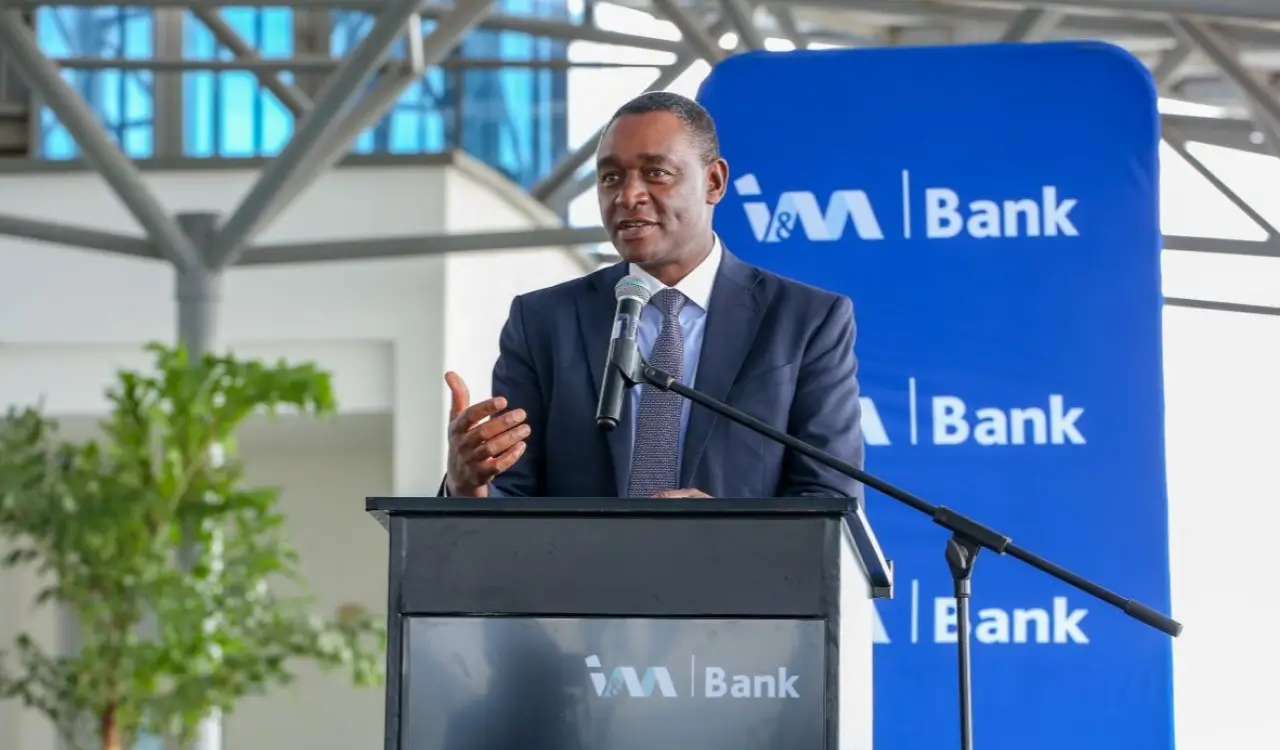
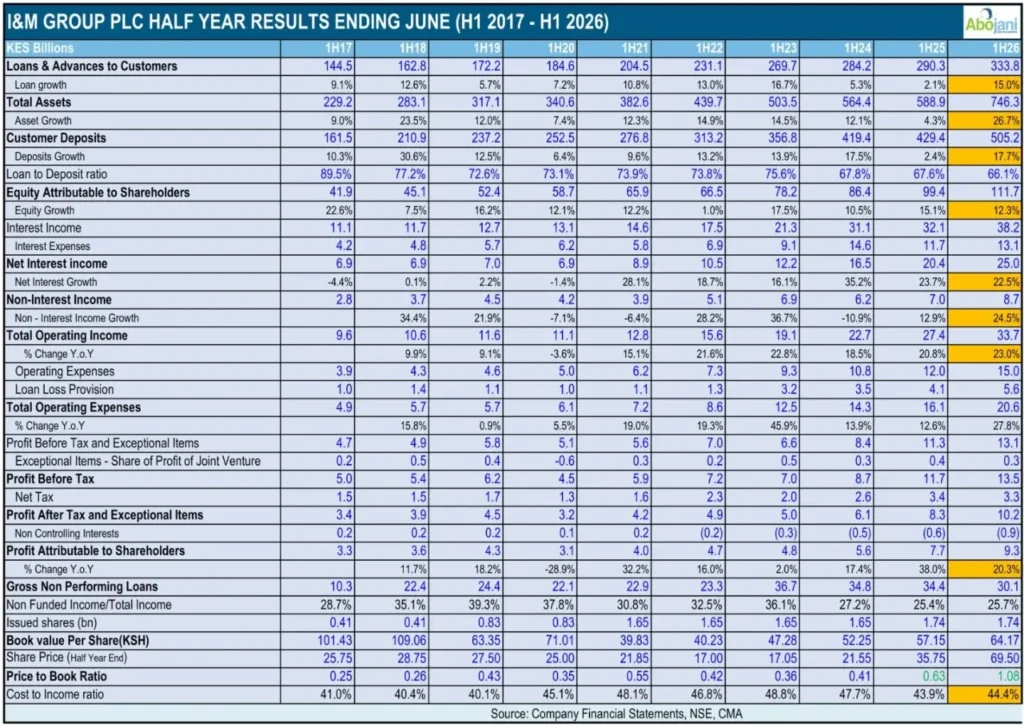
I&M Group has delivered a solid H1 2026 performance, with profit attributable to shareholders rising 20% year-on-year to KSh9.3 billion and profit before tax up 15% to KSh13.5 billion, as broad-based income growth and an increasingly diversified regional franchise offset a flat performance from its largest market, Kenya.
Operating across five East African markets; Kenya, Uganda, Rwanda, Tanzania and Mauritius with more than 1.1 million customers, I&M has spent the last few years building out a regional franchise alongside its home market. In H1 2026, that bet paid off. What stands out in these results is how much of the growth is now coming from outside Kenya.
A regional franchise coming into its own
Kenya remains I&M’s largest and most profitable market, but its dominance is narrowing. The subsidiary’s contribution to Group profit before tax fell to 67%, from 75% a year earlier, as operating income growth of 14% to KSh21.4 billion was largely absorbed by a 34% jump in loan loss provisions, leaving profit before tax essentially flat at KSh8.3 billion and ROE moderating slightly to 17.3%.
The regional subsidiaries, however, delivered stronger aggregate growth. Combined, I&M’s regional subsidiaries lifted their share of Group PBT to 33%, up from 25% in H1 2025; already ahead of the Group’s own 25%-30% medium-term target.
Also read: I&M Group FY 2025: Strong Performance as Profits Rise 22% to KES 19.8B
Rwanda led the charge: profit before tax jumped 53% to KSh2.4 billion, taking its share of Group PBT to 19.7%, from 14.4% in H1 2025. That growth came with genuine balance sheet momentum with total assets up 44% to KSh119 billion, loans up 43% and deposits up 41%. It also registered improving quality, with the gross NPL ratio falling to 1.5% and ROE climbing to 29%, from 23%.
Uganda, while still the smallest subsidiary, posted the sharpest growth in PBT: profit before tax rose 225% to KSh0.7 billion as the cost-to-income ratio improved from 96% to 73% and ROE climbed to 12%, from 4%.
Tanzania grew profit before tax 8% to KSh0.6 billion, with asset quality improving sharply, while its gross NPL ratio nearly halved from 8.6% to 4.2%. Mauritius on the other hand was the outlier, with profit before tax dipping 3% to KSh0.9 billion on higher provisions, trimming its share of Group PBT to 2.7%, from 3.7%.
Group-wide, cross-border business revenues rose 39% to USD 6.1 million, and regional subsidiaries now account for 31% of Group total assets, up from roughly 26% a year earlier. I&M is increasingly a multi-market business rather than a Kenyan bank with regional outposts.
Income growth and a larger, cleaner balance sheet
Total operating income grew 23% to KSh33.7 billion, and profit before provisions rose 22% to KSh18.7 billion, evidence of genuine business momentum. But loan loss provisions climbed 38% to KSh5.6 billion, pushing the Group’s cost of risk up to 3.6%, from 2.8%, which is why profit before tax growth (15%) trailed operating income growth.
Management has described the higher provisioning as a prudent approach to credit risk. At the same time, underlying asset-quality indicators improved with gross NPLs falling over the period. The cost-to-income ratio held broadly steady at 44%.
The balance sheet expanded 27% to KSh746 billion, with customer deposits up 18% to KSh505 billion and net loans and advances up 15% to KSh334 billion. Importantly, growth came with improving quality: gross non-performing loans fell from KSh34 billion to KSh30 billion, taking the net NPA ratio down to 2.3%, from 4.1%. Funding also got cheaper and stickier, with the CASA ratio improving to 53%, from 47%. Capital and liquidity strengthened across all five markets, with the Group’s total capital to risk-weighted assets ratio at 22% and liquidity at 65%.
Diversification beyond corporate banking
The Group’s income mix is also shifting beyond traditional banking. Corporate & Institutional Banking (CIB) grew operating income 22% to KSh10.2 billion, but its share of Group income has narrowed to 30%, from 40% two years ago, as new growth areas including Oil & Gas, the Public Sector, a China Desk and Leasing begin contributing to the franchise.
Retail & Business Banking (RBB) grew income 14% to KSh14.0 billion, with customer numbers up 28% and MSME revenue increasing 41%. But perhaps the clearest evidence of the Group’s diversification is coming from the businesses outside its traditional banking lines. “Other income”, comprising treasury, digital ecosystems and non-banking subsidiaries, now accounts for 28% of Group income, compared with just 2% two years ago.
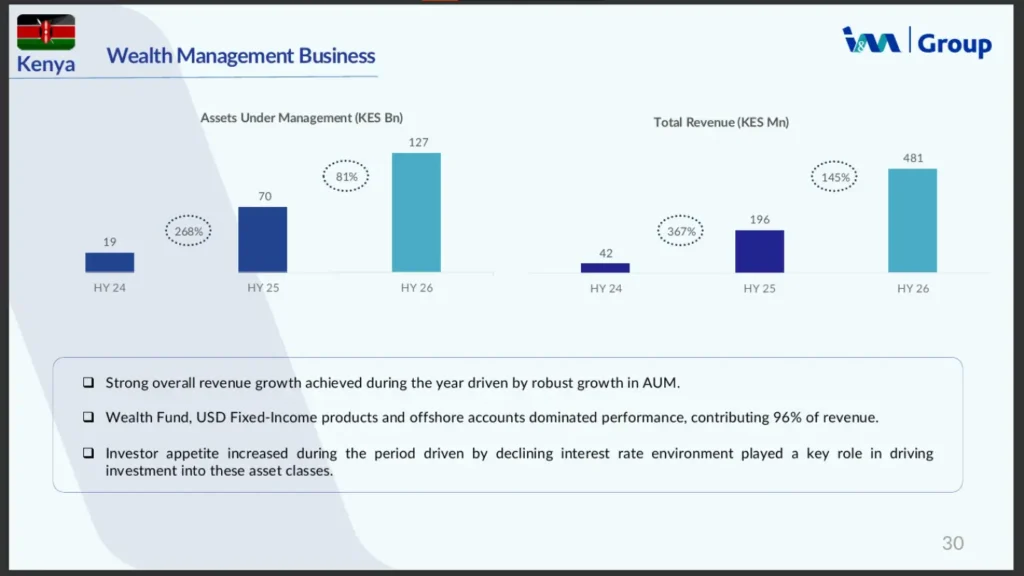
I&M’s Kenyan wealth management business has been particularly notable. Assets under management increased 81% to KSh127 billion, while revenue from the business surged 145% to KSh481 million. Bancassurance also continued to gain momentum, with profit before tax increasing 56% to KSh425 million and ROE reaching 86%.
Digital ecosystem partnerships are contributing to this shift as well, accounting for 21.7% of RBB operating income, up from 14%, with more than KSh4.9 billion disbursed through partnerships spanning payments, digital lending, remittances and e-commerce.
For the shareholders: Earnings per share rose 20% to KSh5.3, and book value per share grew 12% to KSh69. The share price closed at KSh77.00 on 25 August 2026, up 81% year-to-date. The Group also picked up recognition across its markets at the 2026 Global Banking & Finance Awards: Best Bank for Digital Banking Services and Fastest Growing Retail Bank in Kenya, Best Private Bank and Most Innovative Digital Bank in Uganda, and Best Bank for Sustainable Development and Best SME Bank in Rwanda.
I&M’s iMara 3.0 strategy, running through the end of 2026, has already cleared several of its three-year targets: digitally active customers at 92% (target: above 90%), Net Promoter Score at 73% (target: above 70%), and over 17.9 million lives positively impacted (target: above 10 million). Return on equity, at 17%, remains the one headline goal still short of the Group’s 20% aspiration.
Management’s medium-term guidance implies more of the same trajectory. The subsidiary PBT contribution, at 33%, is already running ahead of the Group’s 25%-30% medium-term range, the clearest sign yet that regional diversification isn’t a future ambition for I&M, but a present-tense result.
I&M Group H1 2026: #IMGroupHY2026 #FinancialResults #OnYourSide
CEO & Co-Founder, Abojani Investment
Robert Ochieng is a visionary entrepreneur and the co-founder of Abojani Investment, a leading financial education platform in Kenya that has empowered over 20,000 Africans to embark on their investment journeys. As CEO, he has demonstrated an unwavering commitment to financial literacy, successfully demystifying money and investments and making them accessible and relevant to individuals from all walks of life.
Running Thriving Investment Communities
Robert’s influence extends well beyond Abojani Investment’s core offerings. He has actively fostered a sense of community by running investment forums and groups with a vast following of over 300,000 Africans. These communities provide a safe space for individuals to exchange ideas, share experiences, and support each other on their investment journeys.
Vision for the Future
As co-founder of Abojani Investment, Robert envisions a financially empowered Africa. He strives to expand the reach of his financial education initiatives, enabling millions more to gain the knowledge and confidence needed to achieve their financial goals. His vision is to create a society where every individual has the tools and understanding to build lasting wealth and prosperity.
Professional Background
Robert Ochieng is a highly accomplished CEO at the helm of Abojani Investment, an investment and advisory firm in Kenya. He is a seasoned professional with over 14 years of experience in IT, Finance, and leadership.
His career includes key roles at prominent institutions such as Equity Bank, Gulf African Bank, Guaranty Trust Bank (GTBank) and Airtel.
Robert’s expertise has also been sought after by the National Treasury for consultancy on planning and budgeting systems, showcasing his exceptional knowledge and skills in the field. Passionate about driving meaningful conversations and collaborations between academia, industry, and the public sector, Robert actively engages in research projects focusing on digital transformation within the financial services sector. With his visionary leadership and strategic insights, Robert Ochieng continues to make a significant impact in the business world.