
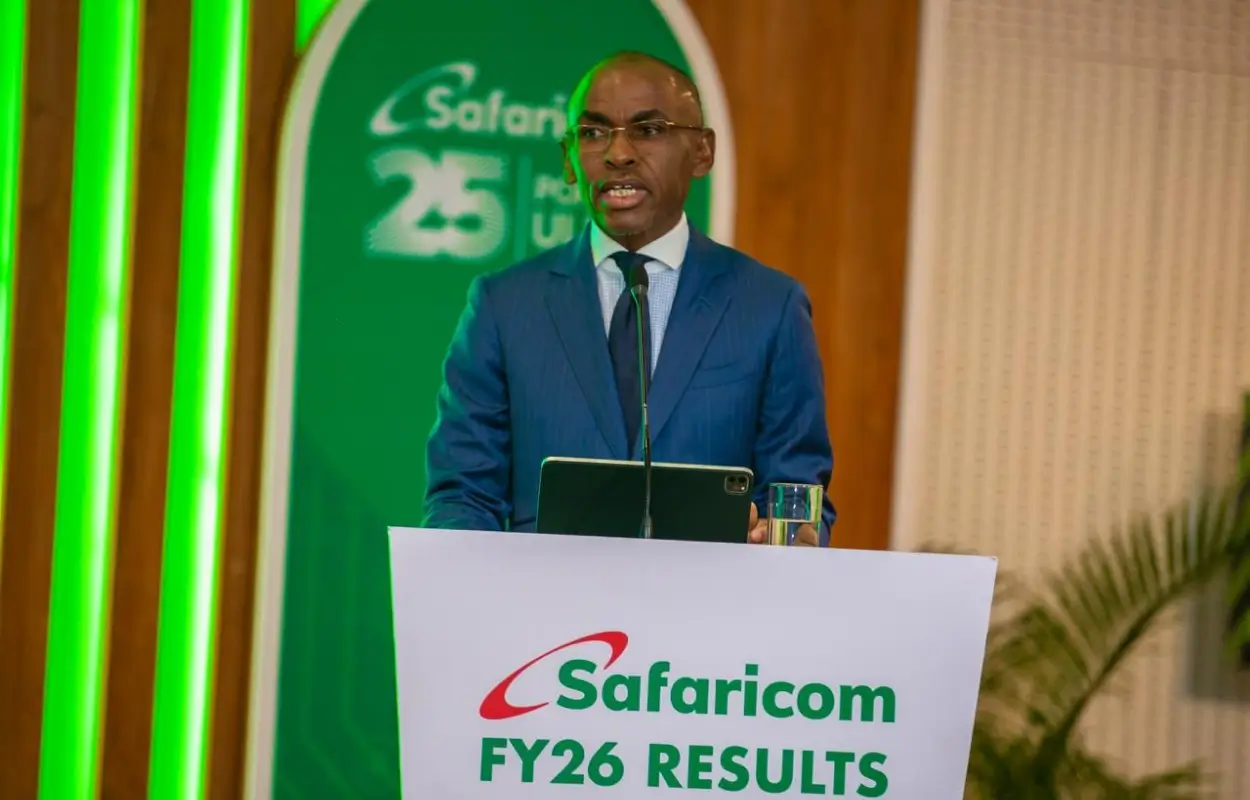
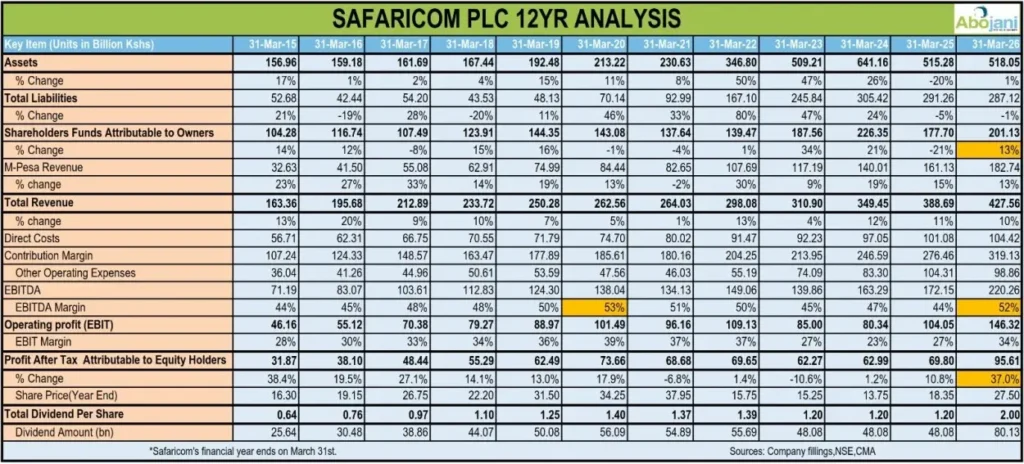
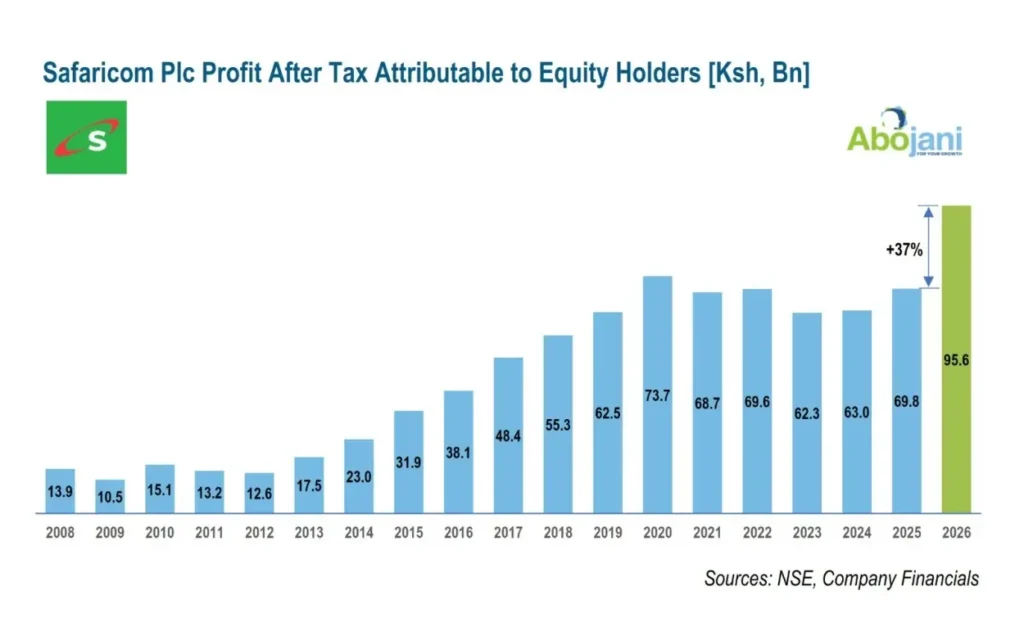
Twenty-five years after launching in Kenya, Safaricom FY2026 has just posted the best results in its history and, in the process, reinforced its position as the most profitable company in East and Central Africa.
Profit after tax attributable to equity holders rose 37% to Ksh 95.6 billion, showing stronger shareholder value creation at group level. Group net income attributable to shareholders hit Ksh 99.7 Billion, a 67.3% jump year on year. Service revenue crossed the Ksh 400 Billion mark to Ksh 414 Billion. The dividend per share reached Ksh 2.00, a new all-time high, up 66.7% from last year. Group EBITDA grew 35.4% to Ksh 220.5 Billion.
This is a company firing on every cylinder at once.
1. Safaricom Kenya
The Kenyan business, which remains the core of the group, delivered service revenue of Ksh 400.8 Billion, growing 10% year on year. EBITDA margins expanded to 56.8%, up from 54.7% two years ago, and net income from the Kenyan business alone came in at Ksh 119.1 Billion, a 24.7% increase.
M-PESA continues to anchor this dominance, contributing Ksh 182.7 billion in revenue; 45.6% of total Kenya service revenue, up 13.4% year on year. Transaction volumes hit 46.4 Billion, up 25.1%, while the total value of transactions processed reached Ksh 41.7 Trillion. The merchant ecosystem has exploded, with total merchants growing 71.4% to 3.1 million, a combination of Lipa na M-PESA and Pochi la Biashara. Pochi alone grew 81.5% in merchant numbers and 86% in revenue.
Mobile data revenue grew 14.4% to Ksh 83.4 Billion, driven by a 31.8% increase in 4G+ devices to 30.8 million. Half of all Safaricom consumers now use more than 1GB of data per month. Fixed service revenue grew 12.2% to Ksh 20.2 Billion, with homes connected up 45.9% year on year to 739,400.
Also read: Corporate Bonds Make a Strong Comeback as Safaricom Celebrates Bell-Ringing At NSE
2. The Wealth Management Story
More importantly, Safaricom is increasingly proving that M-PESA’s future is larger than payments. Ziidi, its money market fund launched in late 2024, grew assets under management 115.1% to Ksh 21 Billion by year end, with 2.2 million active customers, up 250% year on year.
Ziidi Trader, which allows Kenyans to buy and sell NSE-listed shares directly from their phones, has attracted 511,000 opt-ins and 84,000 active traders since launch. This is M-PESA evolving from a payments platform into a full financial services ecosystem, and the numbers show it is working.
3. Ethiopia: The Long Game
In Ethiopia, the losses are still real, with Ksh 21.2 Billion net loss attributable to Safaricom’s share for the year; but they have halved year on year, and the commercial momentum is undeniable.
EBITDA losses improved 64.8% from Ksh 43 Billion to Ksh 15.1 Billion. Service revenue grew 58.3% to Ksh 14.1 Billion. The customer base grew 54.2% to 13.6 million 90-day active customers. M-PESA customers in Ethiopia grew 119.4% to 5.2 million. Capex has been cut 52.2% as the network build phase matures, and EBITDA breakeven is now the stated target for FY2027.
The second half of FY2026 was particularly telling. H2 EBITDA losses were just Ksh 2.7 Billion compared to Ksh 12.4 Billion in H1, highlighting a business that is rapidly approaching the point where it starts contributing rather than consuming. Regulatory-led price corrections in Q4 delivered a sharp uplift in both voice and data revenue, with voice revenue growing 33.8% quarter on quarter in Q4 alone.
Catch more insights from our Ask the Expert series featuring Safaricom Group CFO, Mr. Dilip Pal, as he explains the Safaricom FY2026 results.
4. The Technology Company Vision Is Taking Shape
Peter Ndegwa has spoken consistently about Safaricom’s ambition to become Africa’s leading purpose-led technology company by 2030. FY2026 is the first year of that five-year strategy cycle, and the early evidence suggests execution is ahead of schedule.
Fintech 2.0, launched in October 2025, has already unlocked shared wallets through Shiriki Pay with over 1 million users, NFC Tap to Pay on pilot, enhanced AI-powered fraud prevention, and tripled TPS capacity for Fuliza. The platform now processes 6,000 transactions per second with a future-ready capacity of 12,000 TPS. The M-PESA super app has 6.6 million active consumer users, up 40% year on year, transacting Ksh 3.1 Trillion in value.
On the enterprise and public sector side, 6,500 public health facilities are now connected. 29.7 million citizens are registered on the health system. The fertiliser e-subsidy programme has reached 6.3 million farmers with Ksh 74 Billion disbursed since inception. 91,000 youth across all 47 counties have been supported through the government’s youth empowerment programme.
70+ AI and machine learning models are now in production. The company has 400 developers working in agile, 149,000 ecosystem developers on the Daraja API platform, and is building what it describes as an AI Factory to accelerate the transition to a fully intelligent organisation.
5. A Company That Has Chosen a Different Definition of Success
What distinguishes Safaricom from a purely commercial story is the consistency with which it invests in the communities it serves. In safaricom full year results 2026, the M-PESA Foundation and Safaricom Foundation combined to touch 4.4 million lives.
17.1 billion free M-PESA micro-transactions were enabled through the Kadogo programme; representing 36.8% of total M-PESA volumes, specifically designed to ensure that the lowest-income users are not excluded from the financial system by transaction costs.
Education programmes expanded digital access, scholarships, and teacher training across all 47 counties and their health initiatives reached tens of thousands through maternal health, free medical camps, and life-restoring surgeries.

6. Investors’ Share
Since listing, Safaricom has paid Ksh 692.25 billion in dividends, including Ksh 280 billion in the last five years alone. The FY2026 dividend of Ksh 2.00 per share, comprising an interim Ksh 0.85 and proposed final Ksh 1.15, is the highest in company history.
For FY2027, management has guided Kenya EBIT of Ksh 195 – 199 Billion, up from Ksh 182.3 Billion. Ethiopia losses are expected to narrow further to between Ksh 12 – 15 Billion, with EBITDA breakeven the stated target. The strategic focus includes building a converged fintech ecosystem, deepening AI capabilities, scaling segmented customer propositions, and deepening trust across customers and society.
Twenty-five years in, with 71.6 million customers across its markets, Safaricom is not slowing down. If anything, it may now be entering an era where its greatest value is not just in how much profit it generates, but in how central it becomes to the daily economic architecture of millions.
#Safaricom FY2026 Results
CEO & Co-Founder, Abojani Investment
Robert Ochieng is a visionary entrepreneur and the co-founder of Abojani Investment, a leading financial education platform in Kenya that has empowered over 20,000 Africans to embark on their investment journeys. As CEO, he has demonstrated an unwavering commitment to financial literacy, successfully demystifying money and investments and making them accessible and relevant to individuals from all walks of life.
Running Thriving Investment Communities
Robert’s influence extends well beyond Abojani Investment’s core offerings. He has actively fostered a sense of community by running investment forums and groups with a vast following of over 300,000 Africans. These communities provide a safe space for individuals to exchange ideas, share experiences, and support each other on their investment journeys.
Vision for the Future
As co-founder of Abojani Investment, Robert envisions a financially empowered Africa. He strives to expand the reach of his financial education initiatives, enabling millions more to gain the knowledge and confidence needed to achieve their financial goals. His vision is to create a society where every individual has the tools and understanding to build lasting wealth and prosperity.
Professional Background
Robert Ochieng is a highly accomplished CEO at the helm of Abojani Investment, an investment and advisory firm in Kenya. He is a seasoned professional with over 14 years of experience in IT, Finance, and leadership.
His career includes key roles at prominent institutions such as Equity Bank, Gulf African Bank, Guaranty Trust Bank (GTBank) and Airtel.
Robert’s expertise has also been sought after by the National Treasury for consultancy on planning and budgeting systems, showcasing his exceptional knowledge and skills in the field. Passionate about driving meaningful conversations and collaborations between academia, industry, and the public sector, Robert actively engages in research projects focusing on digital transformation within the financial services sector. With his visionary leadership and strategic insights, Robert Ochieng continues to make a significant impact in the business world.