
Entrepreneurship is often portrayed as a race to secure funding. Headlines celebrate million-dollar investment rounds, venture capital deals and rapid expansion, leaving many aspiring founders believing that capital is the first ingredient for building a successful business.
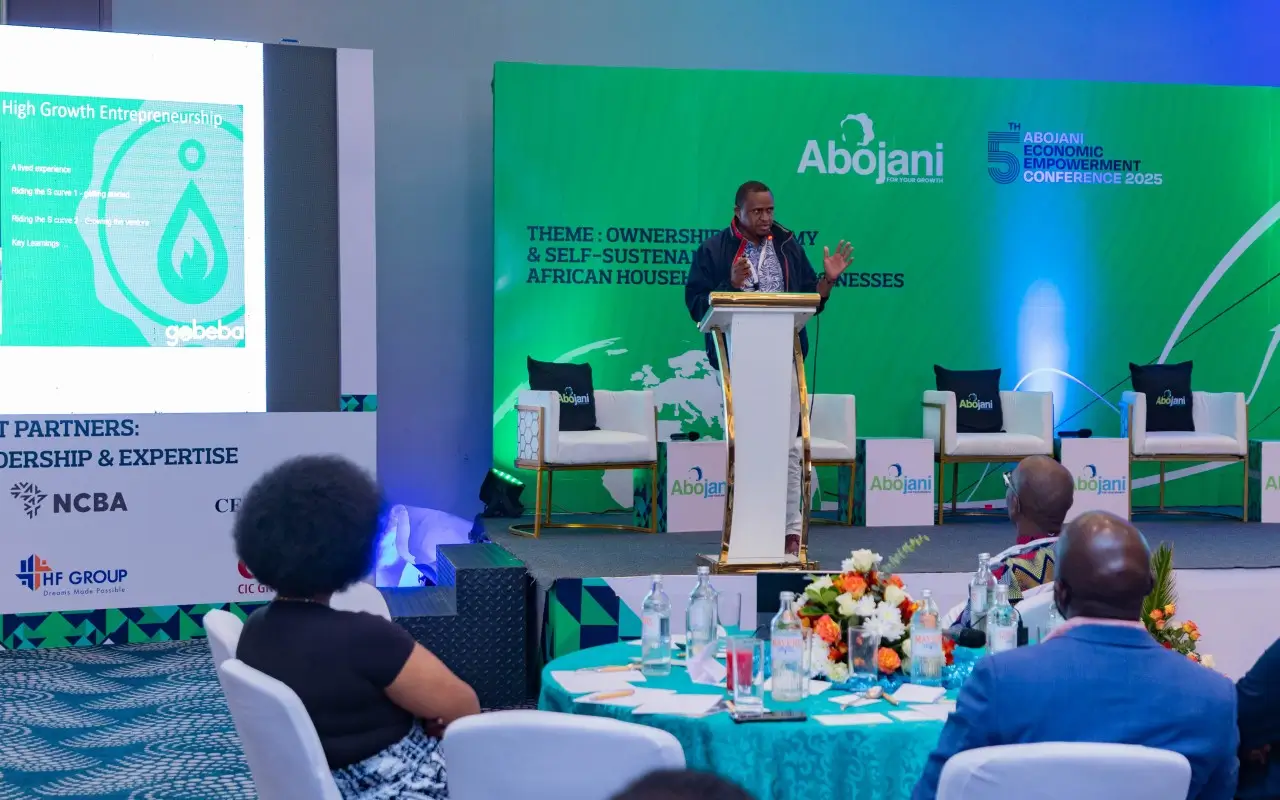
Peter Ndiang’ui, CEO and Co-founder of GoBEBA, offered a different perspective during the 5th Abojani Economic Empowerment Conference. His overarching message was simple: before seeking investors, entrepreneurs need something far more valuable, savings.
Drawing from GoBEBA’s journey, he demonstrated that commercializing an idea is rarely a straight path. It is a process of experimentation, learning and continuous refinement. Without financial breathing room, many promising businesses fail before they ever discover the model that works.
GoBEBA was born out of a simple observation. Millions of Kenyans rely on cooking gas and drinking water every day, yet accessing these essentials is often inconvenient and, in some cases, unsafe. Consumers are often forced to choose between carrying heavy gas cylinders themselves or relying on delivery services without certainty about the authenticity of the products they received.
Rather than assuming there was demand, the founders set out to validate the problem.
Their first attempt was a Facebook advertisement. Despite attracting plenty of attention, it generated no orders.
Instead of concluding that the business would not work, they tried something different. They printed simple posters and placed them at a service station. Before the day ended, the first customer called.
That first order revealed challenges no business plan could predict. There was no inventory, no delivery network and no sophisticated technology. Peter personally collected cylinders from the station after leaving a deposit, loaded them into his own car and delivered them to different customers. Four deliveries later, it was obvious the idea had potential, but it also became clear that the operating model needed work.
Those early experiments became the foundation of GoBEBA.
Working with Vivo Energy helped accelerate growth as branded posters were rolled out across multiple service stations, increasing customer awareness. As orders grew, the founders invested in a customized WordPress website and digital marketing, gradually building a more structured operation.
After three months, they had validated three critical lessons:
- There was genuine customer demand.
- The ordering process was simple enough for customers to adopt.
- However, the revenue model still required refinement.
Initially, the business relied on commissions from suppliers, earning only around 6% per transaction. Over the following years, the company continued experimenting. Some ideas, including expanding into food delivery, proved difficult to sustain. Other decisions were far more transformative.
Perhaps the biggest shift came when GoBEBA decided to hold inventory, despite initially believing in an asset-light business model.
Owning inventory reduced delivery times from 45 minutes to just 25 minutes while increasing margins from approximately6% to more than 20%.
The business had evolved.
Later, GoBEBA moved beyond deliveries and began offering technology solutions for brands, helping businesses manage customer orders and fulfillment through channels such as WhatsApp. What began as a delivery company had gradually become a commerce infrastructure provider.
Interestingly, much of this growth was driven by returning customers rather than constant customer acquisition, demonstrating that solving a genuine problem creates loyalty.
What Were the Key Learnings From GoBEBA’s Story?
- Throughout the presentation, Peter repeatedly returned to one lesson: none of this experimentation would have been possible without savings.
“Building a high growth business is like herding cats,” he said. For the first two years, traction may be minimal while founders test assumptions, refine products and adjust their business models. Without savings, entrepreneurs often feel pressured to pursue short-term results or give away significant ownership simply to survive.
- He also cautioned entrepreneurs against one of the most common mistakes in today’s startup ecosystem, investing too heavily in technology too early.
Many founders build sophisticated applications before understanding whether customers actually want the product. Technology should support a proven business model, not replace the process of discovering one.
- Another thing he pointed out was that an entrepreneur’s role is not just building businesses, but creating new markets.
That is an extremely difficult task. As Peter’s journey shows, founders must be willing to move through the early market stage, where adoption is slow and uncertain, and keep pushing until they reach the early majority, where the business begins to scale more predictably. That transition takes time, resilience and enough financial stability to keep going when progress is still fragile.
- Funding was another area where Peter challenged conventional thinking.
Equity financing, while valuable, comes at a cost. Whenever possible, founders should first seek funding from customers, suppliers and internally generated cash flows. When external capital becomes necessary, entrepreneurs should look for investors who are patient with growth but disciplined about long-term profitability.
His final message extended beyond business itself.
Entrepreneurship places enormous financial pressure on families. Savings do more than finance operations. They provide stability during uncertain periods, reduce unnecessary pressure on the business and allow founders to make decisions based on long-term value instead of immediate survival.
The GoBEBA story reminds us that successful businesses are rarely created through perfect plans or abundant funding. They emerge through persistence, continuous experimentation and the financial resilience to keep learning until the model works.
#Entrepreneurship

CEO & Co-Founder, Abojani Investment
Robert Ochieng is a visionary entrepreneur and the co-founder of Abojani Investment, a leading financial education platform in Kenya that has empowered over 20,000 Africans to embark on their investment journeys. As CEO, he has demonstrated an unwavering commitment to financial literacy, successfully demystifying money and investments and making them accessible and relevant to individuals from all walks of life.
Running Thriving Investment Communities
Robert’s influence extends well beyond Abojani Investment’s core offerings. He has actively fostered a sense of community by running investment forums and groups with a vast following of over 300,000 Africans. These communities provide a safe space for individuals to exchange ideas, share experiences, and support each other on their investment journeys.
Vision for the Future
As co-founder of Abojani Investment, Robert envisions a financially empowered Africa. He strives to expand the reach of his financial education initiatives, enabling millions more to gain the knowledge and confidence needed to achieve their financial goals. His vision is to create a society where every individual has the tools and understanding to build lasting wealth and prosperity.
Professional Background
Robert Ochieng is a highly accomplished CEO at the helm of Abojani Investment, an investment and advisory firm in Kenya. He is a seasoned professional with over 14 years of experience in IT, Finance, and leadership.
His career includes key roles at prominent institutions such as Equity Bank, Gulf African Bank, Guaranty Trust Bank (GTBank) and Airtel.
Robert’s expertise has also been sought after by the National Treasury for consultancy on planning and budgeting systems, showcasing his exceptional knowledge and skills in the field. Passionate about driving meaningful conversations and collaborations between academia, industry, and the public sector, Robert actively engages in research projects focusing on digital transformation within the financial services sector. With his visionary leadership and strategic insights, Robert Ochieng continues to make a significant impact in the business world.