
Safaricom has reported a strong first half of FY27, with Group net income rising 35.9% to KSh58.2 billion for the six months ended 30 September 2026, as revenue growth in Kenya was complemented by a sharp reduction in losses at its Ethiopian operation.
Group service revenue increased 13.1% to KSh226.1 billion, while EBITDA grew 27.5% to KSh129.2 billion. The stronger growth in profitability lifted the Group’s EBITDA margin from 49.5% in H1 FY26 to 55.3% in H1 FY27. Group EBIT also rose 39.8% to KSh91.1 billion, while operating free cash flow increased 59.1% to KSh74.5 billion.
The result means Safaricom is growing not only its revenue base, but also the amount of earnings and cash generated from that revenue. The performance was anchored by Safaricom Kenya, which continues to provide the bulk of the Group’s earnings, while Ethiopia is increasingly becoming a source of growth.
Kenya continues to carry the Group
Safaricom Kenya recorded service revenue of KSh216.0 billion, an 11.3% increase from the previous year. EBIT grew 13.7% to KSh101.8 billion, taking the Kenyan business past the KSh100 billion mark for the first time in a six-month reporting period.
The milestone is particularly notable because EBIT grew faster than revenue, pointing to continued operating leverage within the Kenyan business.
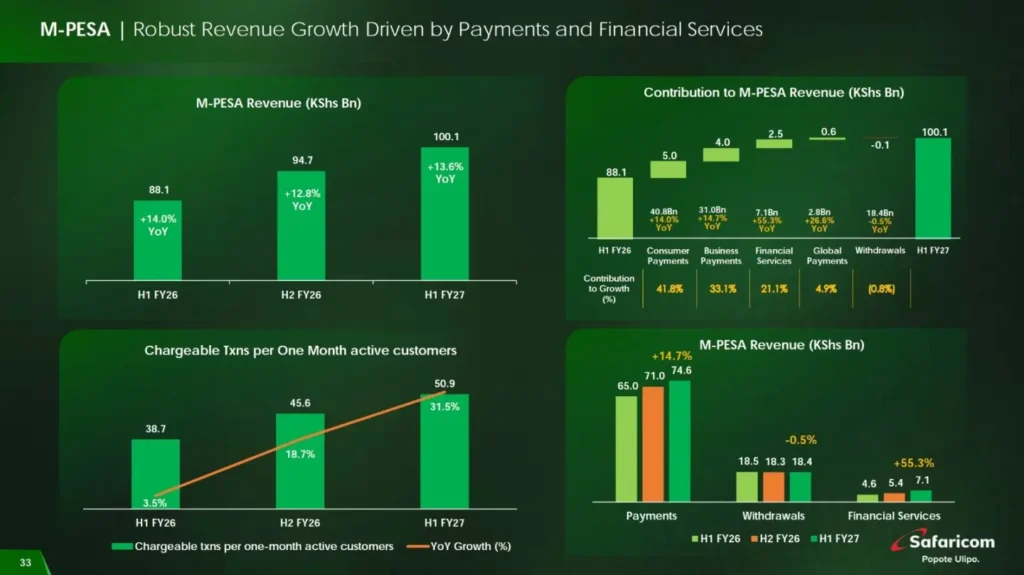
M-PESA remains a major contributor to this performance. Group M-PESA revenue increased 13.6% to KSh100.1 billion, crossing the KSh100 billion mark for the first time in a half-year period.
The composition of that revenue also shows how the platform continues to evolve. Consumer payments generated KSh40.8 billion, while business payments contributed KSh31.0 billion. Financial services revenue was up 55.3% to KSh7.1 billion, while global payments increased 26.6% to KSh2.8 billion.
Transaction activity has also expanded significantly. M-PESA processed 27.4 billion transactions during the six months, 25.2% more than in H1 FY26. Chargeable transactions increased 10.1%, while non-chargeable transactions grew by 48.2%.
This is important because the growth of M-PESA is not simply about charging more customers for more transactions. Safaricom says 53% of all M-PESA transactions remained free or zero-rated during the period. Approximately 81% of Lipa na M-PESA and Pochi la Biashara merchant transactions and 63% of consumer transactions were also free.
The platform is therefore supporting a much larger volume of economic activity while increasingly creating value through a wider range of services around the payments ecosystem.
The ambition is to build on M-PESA’s position as a payments platform and extend it further into financial services and commerce.
Ethiopia is closing the gap
The other major development in the half-year results is the pace at which Safaricom Ethiopia is moving towards profitability.
The Ethiopian operation increased service revenue by 71.6% to KSh10.6 billion, while its 90-day active customer base grew 38.4% to 15.4 million. Its 30-day active customer base reached 12.2 million, up 43.4%.
Customer growth is being accompanied by greater usage of the company’s digital services. Mobile data customers increased 37% to 12.1 million, while M-PESA customers grew 54.6% to 5.2 million.
Mobile data remains the largest component of Ethiopia’s service revenue, accounting for 74% of the total. Data revenue itself grew 90.2% year on year.
But the more significant change for the Group is the reduction in losses.
Safaricom Ethiopia’s EBITDA loss narrowed from KSh12.6 billion in H1 FY26 to KSh434.4 million in H1 FY27, representing a 96.5% improvement. The business’s EBIT loss narrowed from KSh24.3 billion to KSh11.4 billion, while its net loss excluding minority interests improved from KSh15.5 billion to KSh8.8 billion.
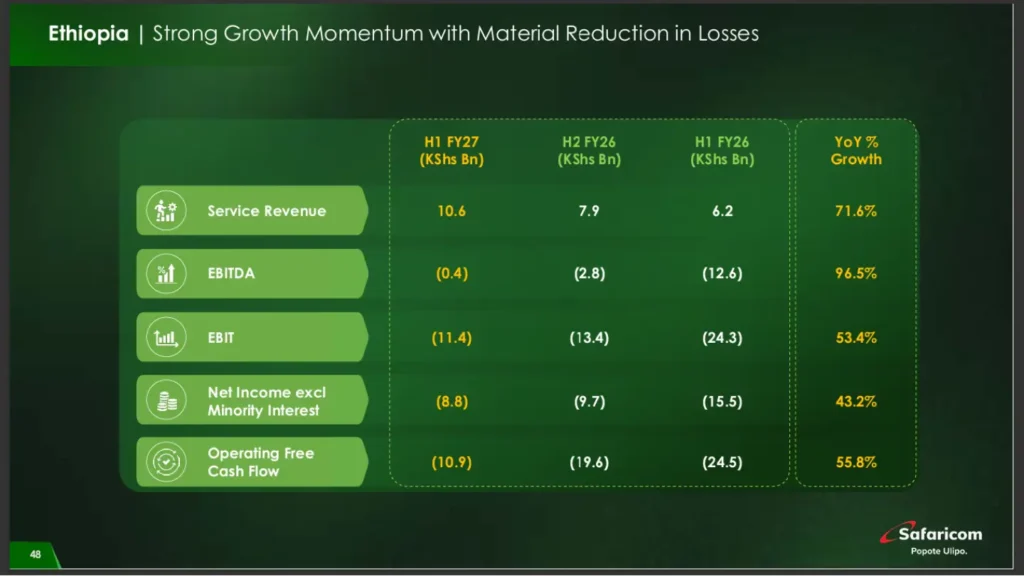
Ethiopia is therefore still loss-making at the net income and EBIT levels, but the distance to operational break-even has narrowed substantially.
Safaricom says Ethiopia contributed 17.9% of the Group’s service revenue growth during the period, underlining its increasing importance to the Group’s overall expansion.
The company has retained its target of reaching EBITDA break-even in Ethiopia by the end of FY27. For a business that has required significant investment since entering the market, reaching that point would mark an important transition from the build-out phase towards a more commercially mature operation.
Building beyond the traditional telecoms business
The half-year performance also reflects a broader shift in what Safaricom is trying to become.
Connectivity remains at the centre of the business, but the company is increasingly building services around that infrastructure. In Kenya, Safaricom has expanded its fixed connectivity footprint to approximately 900,000 homes passed and around 474,000 fibre connections, while fixed and mobile convergence remains a key part of its consumer strategy.
M-PESA is similarly being developed beyond conventional payments. Safaricom has continued expanding merchant payment capabilities through QR, Tap-to-Pay and point-of-sale integrations. It has also launched Shiriki Pay, which allows groups to share and manage M-PESA funds, while continuing to develop its My OneApp as a unified platform for connectivity, financial services, commerce and personalised customer value.
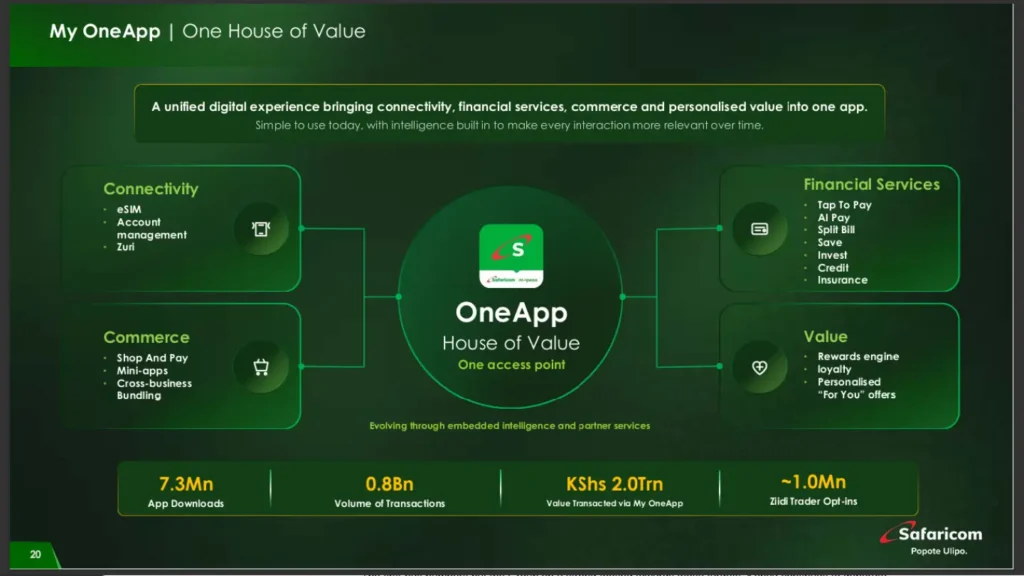
This creates a different growth opportunity from simply adding more mobile subscribers. Safaricom can increasingly monetise the relationships and activity that already exist across its network.
Artificial intelligence is another part of the company’s next phase. Its H2 FY27 priorities include scaling AI use cases, strengthening internal capabilities and developing an AI-first OneApp experience. The company is also targeting growth in enterprise services beyond connectivity, including SD-WAN, managed services and digital platforms for the public sector.
The strategy points towards a business where telecommunications infrastructure remains the foundation, but financial services, digital products, enterprise technology and commerce increasingly sit on top of it.
A strong first half sets up the second
Safaricom has retained its FY27 guidance, with Group EBIT expected to fall between KSh180 billion and KSh187 billion. This compares with KSh153.9 billion achieved in FY26.
For Kenya, the company is targeting EBIT of KSh195 billion to KSh199 billion, compared with KSh182.3 billion in FY26. Ethiopia is expected to report an EBIT loss of between KSh12 billion and KSh15 billion, a substantial improvement from the KSh30.1 billion loss recorded in FY26.
The first-half numbers put the Group on a strong footing towards those targets. Kenya continues to generate the earnings and cash that underpin the business, while M-PESA is expanding into a broader financial services ecosystem. At the same time, Ethiopia is moving rapidly towards operational break-even and contributing a growing share of Group revenue growth.
For now, the H1 FY27 results suggest that Safaricom’s growth story still has considerable room to run, with its core businesses strengthening as newer opportunities begin to contribute.
CEO & Co-Founder, Abojani Investment
Robert Ochieng is a visionary entrepreneur and the co-founder of Abojani Investment, a leading financial education platform in Kenya that has empowered over 20,000 Africans to embark on their investment journeys. As CEO, he has demonstrated an unwavering commitment to financial literacy, successfully demystifying money and investments and making them accessible and relevant to individuals from all walks of life.
Running Thriving Investment Communities
Robert’s influence extends well beyond Abojani Investment’s core offerings. He has actively fostered a sense of community by running investment forums and groups with a vast following of over 300,000 Africans. These communities provide a safe space for individuals to exchange ideas, share experiences, and support each other on their investment journeys.
Vision for the Future
As co-founder of Abojani Investment, Robert envisions a financially empowered Africa. He strives to expand the reach of his financial education initiatives, enabling millions more to gain the knowledge and confidence needed to achieve their financial goals. His vision is to create a society where every individual has the tools and understanding to build lasting wealth and prosperity.
Professional Background
Robert Ochieng is a highly accomplished CEO at the helm of Abojani Investment, an investment and advisory firm in Kenya. He is a seasoned professional with over 14 years of experience in IT, Finance, and leadership.
His career includes key roles at prominent institutions such as Equity Bank, Gulf African Bank, Guaranty Trust Bank (GTBank) and Airtel.
Robert’s expertise has also been sought after by the National Treasury for consultancy on planning and budgeting systems, showcasing his exceptional knowledge and skills in the field. Passionate about driving meaningful conversations and collaborations between academia, industry, and the public sector, Robert actively engages in research projects focusing on digital transformation within the financial services sector. With his visionary leadership and strategic insights, Robert Ochieng continues to make a significant impact in the business world.