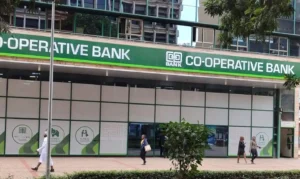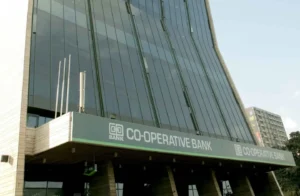

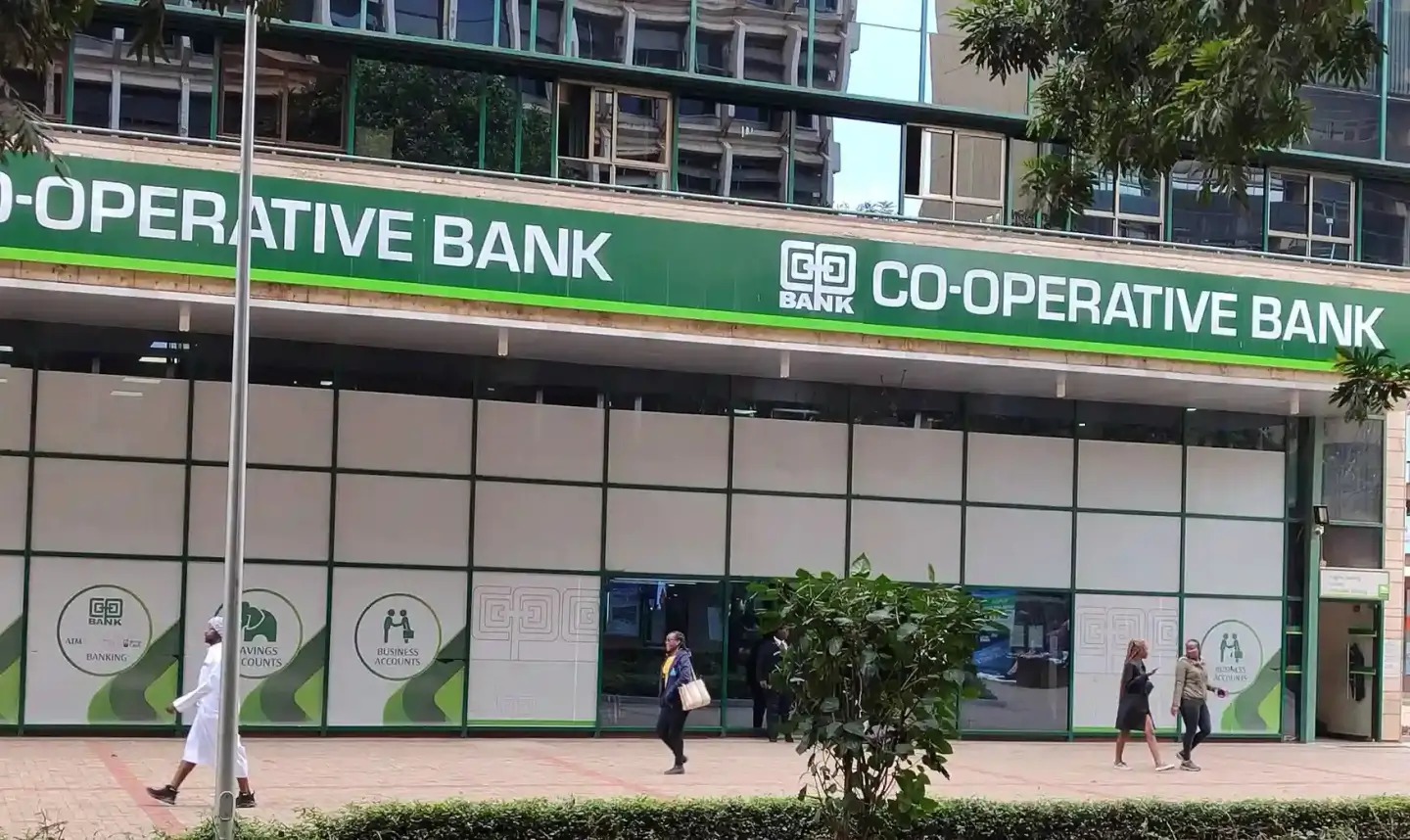
The story of Co-Operative Bank Of Kenya (Co-op Bank) is not one of Silicon Valley style disruption, or aggressive corporate takeovers. Co-op, whose headquarters sit pretty in the Nairobi CBD, is a masterclass in social architecture.
Walk with us as we unpack some interesting perspectives on this lender that has stood the test of time, having existed for close to 6 decades now.
Co-op Bank only registered under the Co-operative Societies Act in 1965 and the Co-operative Bank of Kenya Limited would then open its doors three years later, before converting into a full-fledged commercial bank in 1994.
When Kenya gained independence, the traditional banking system was fundamentally colonial, corporate, and urban-centric. Smallholder coffee farmers, tea pluckers, and rural merchants were locked out of formal credit lines.
Also read: How Co-op Bank Grew From a Farmers’ Cooperative to a Modern Financial Group
Since back in the 60s, Co-op Bank was designed with a unique social mandate to provide the financial infrastructure for the country’s burgeoning cooperative movement. And for its first four decades, it didn’t focus on high-net-worth individuals. Instead, it operated as the central engine for Savings and Credit Co-operative Societies (SACCOs). If you were a rural dairy farmer or a schoolteacher pooling money in a local Chama, Co-op Bank was the institution handling your liquidity and guaranteeing your credit line.
By the mid-2000s, to compete with global banking groups expanding across Africa, Co-op Bank needed serious tier-one capital. On December 22, 2008, the bank made its historic debut on the Nairobi Securities Exchange (NSE). Navigating a challenging macroeconomic landscape shaped by high global inflation and the aftermath of the 2008 global financial crisis, the IPO ultimately achieved an 81% subscription rate. The public offer successfully netted KSh 5.4 billion in capital and the capital injection safely fortified the bank’s tier-one capital status.
In the 2010s, critics had argued that Co-op Bank was too slow and rural to survive the digital revolution.
What they did not know was that the next 5 years after the IPO were the most significant years for the bank. Co-op went firing on all cylinders, opening over 77 new branches with customer accounts growing from 700,000 to 4.1Mn. By the time the popular Soaring Eagle Transformation Agenda was being launched, the foundation was all set and there was no looking back.
Today, The Co-operative Bank of Kenya Ltd is the third-largest tier-one bank in the region, managing Ksh. 869.5 Billion in total assets and holding a market capitalization of Ksh 210 Billion. Co-op is also the 3rd most profitable banks in the country, and this is especially outstanding because the bank operates only in Kenya and South Sudan as opposed to peers who operate in almost every other market in East Africa.
The man at the helm is one Dr. Gideon Muriuki, who was appointed Managing Director in 2001 and has led the Bank’s turnaround from a loss position of Kshs. 2.3Bn in 2000 to a profit before tax of KShs. 40.3Bn in 2025.
To know Dr. Gideon is to know that Co-op DNA is with him. Rather than trying to change the bank’s identity to mimic foreign competitors, he embraced its roots. He realized that the bank’s greatest strength lay in its connection to everyday Kenyans.
As we speak, the lender is in the second year of its ‘Good to Great’ Strategy 2025 – 2029. This forward-looking framework balances aggressive market dominance across Kenya and the wider region with a steadfast commitment to remaining the primary financial backbone of the domestic co-operative movement. Notably, the bank aims to elevate customer experiences seamlessly across all touchpoints while maintaining an optimal enterprise risk and compliance stance.
Co-op Bank’s competitive moat relies on a highly protected approach to its assets and liabilities:
- Low-Cost Deposit Capture: Because the bank is the primary clearing house for the nation’s SACCOs, it captures a massive volume of low-cost Current and Savings Accounts (CASA). Over 54.2% of its total deposit base consists of stable, transactional deposits, which keeps its funding costs down.
- The Check-Off Safety Net: A dominant 50.9% of its total loan book is dedicated to Personal Consumer banking. The vast majority of these loans are structured on a “check-off” model. Repayments are automatically deducted directly from government or corporate payrolls at the source before the salary ever reaches the client’s account.
- Low High-Risk Exposure: The bank maintains remarkably small loan allocations to traditionally high-risk, volatile sectors like manufacturing (4.6%), building & construction (0.6%), and real estate (7.8%). This choice has brought the bank’s NPL ratio down to 13.6%, well below the wider Kenyan banking industry average of 15.3% as of HY2026.
Looking deeper into the balance sheet, the bank continues to show strong, consistent compounding numbers:
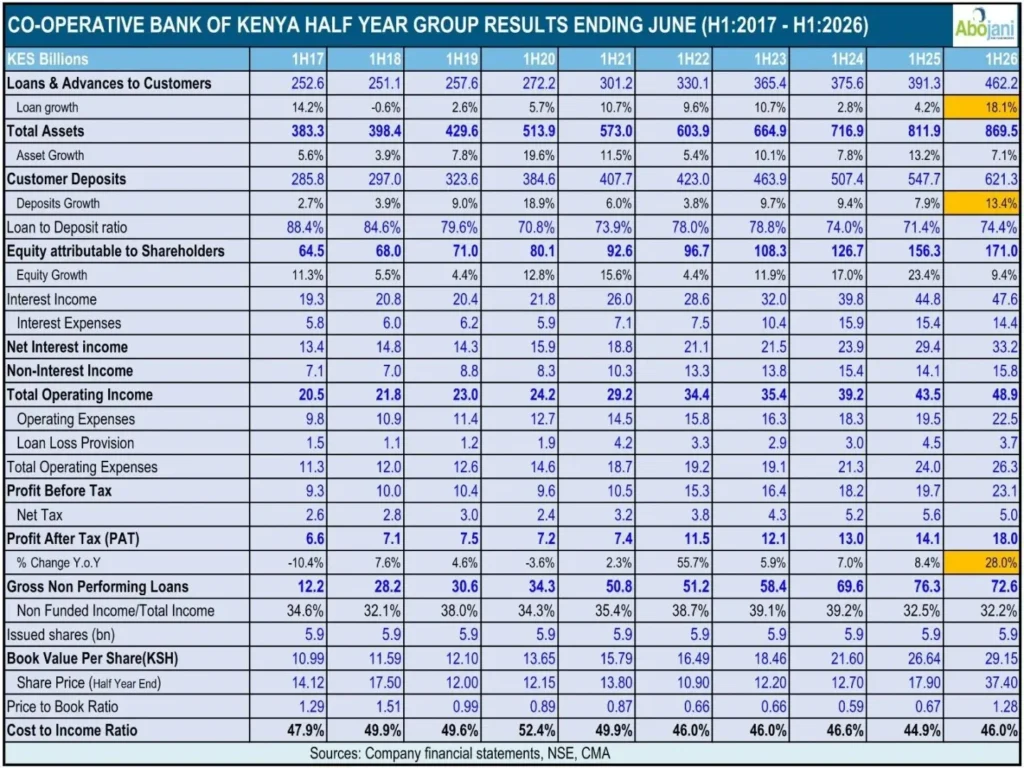
H1 2026 Consolidated Results
- Profit Before Tax: Ksh. 23.1 Billion (up 17.3% from Ksh. 19.7 Billion in H1 2025).
- Total Asset Base: Ksh. 869.5 Billion (a 7.1% increase).
- Net Loans & Advances: Ksh. 462.2 Billion (growing by 18.1%).
- Total Customer Deposits: Ksh. 623.2 Billion (up 11.2%).
- Capital Adequacy: Total Capital to Risk-Weighted Assets stands at 22.9%, significantly higher than the statutory minimum requirement of 14.5%.
The financial performance of the bank has ignited an extraordinary bull run on the Nairobi Securities Exchange, turning the stock into one of the market’s most compelling growth stories.
The share price closed at a striking Ksh 35.75 yesterday, marking a phenomenal 49.3% gain year-to-date and an even more impressive 70.2% surge over the past year, comfortably outperforming the broader market index.
This rally reached a thrilling fever pitch in August 2026 when the stock hit an historic all-time high of Ksh 39.95.
Yet, beyond this, Co-op remains a crown jewel for income-focused portfolios. The rollout of the ‘Good to Great’ Strategy has delivered immediate financial goodies to shareholders, shattering historical distribution precedents.
In FY2025, the lender rewarded investors with a record-breaking total dividend of KSh 2.50 per share, representing a phenomenal 66.6% year-on-year increase. This historic distribution comprised a KSh 1.00 interim dividend and a KSh 1.50 final dividend.
Q3 2026 results are coming in this month, will the bank pay yet another interim dividend? Let’s wait and see!
Let’s also remember that in line with modern industry practices, the Board of Directors recently approved a proposed transition to a Non-Operating Holding Company (NOHC) structure under the applicable Banking Act and Central Bank of Kenya Prudential Guidelines.
So, the existing listed entity will be renamed CO-OPBANK GROUP PLC, serving as the umbrella holding company that retains its slot on the NSE while housing all subsidiaries. Meanwhile, a new, wholly owned banking subsidiary, CO-OP BANK KENYA LTD, will be incorporated to run the core domestic banking operations.#
#Co-Operative Bank Of Kenya

CEO & Co-Founder, Abojani Investment
Robert Ochieng is a visionary entrepreneur and the co-founder of Abojani Investment, a leading financial education platform in Kenya that has empowered over 20,000 Africans to embark on their investment journeys. As CEO, he has demonstrated an unwavering commitment to financial literacy, successfully demystifying money and investments and making them accessible and relevant to individuals from all walks of life.
Running Thriving Investment Communities
Robert’s influence extends well beyond Abojani Investment’s core offerings. He has actively fostered a sense of community by running investment forums and groups with a vast following of over 300,000 Africans. These communities provide a safe space for individuals to exchange ideas, share experiences, and support each other on their investment journeys.
Vision for the Future
As co-founder of Abojani Investment, Robert envisions a financially empowered Africa. He strives to expand the reach of his financial education initiatives, enabling millions more to gain the knowledge and confidence needed to achieve their financial goals. His vision is to create a society where every individual has the tools and understanding to build lasting wealth and prosperity.
Professional Background
Robert Ochieng is a highly accomplished CEO at the helm of Abojani Investment, an investment and advisory firm in Kenya. He is a seasoned professional with over 14 years of experience in IT, Finance, and leadership.
His career includes key roles at prominent institutions such as Equity Bank, Gulf African Bank, Guaranty Trust Bank (GTBank) and Airtel.
Robert’s expertise has also been sought after by the National Treasury for consultancy on planning and budgeting systems, showcasing his exceptional knowledge and skills in the field. Passionate about driving meaningful conversations and collaborations between academia, industry, and the public sector, Robert actively engages in research projects focusing on digital transformation within the financial services sector. With his visionary leadership and strategic insights, Robert Ochieng continues to make a significant impact in the business world.