
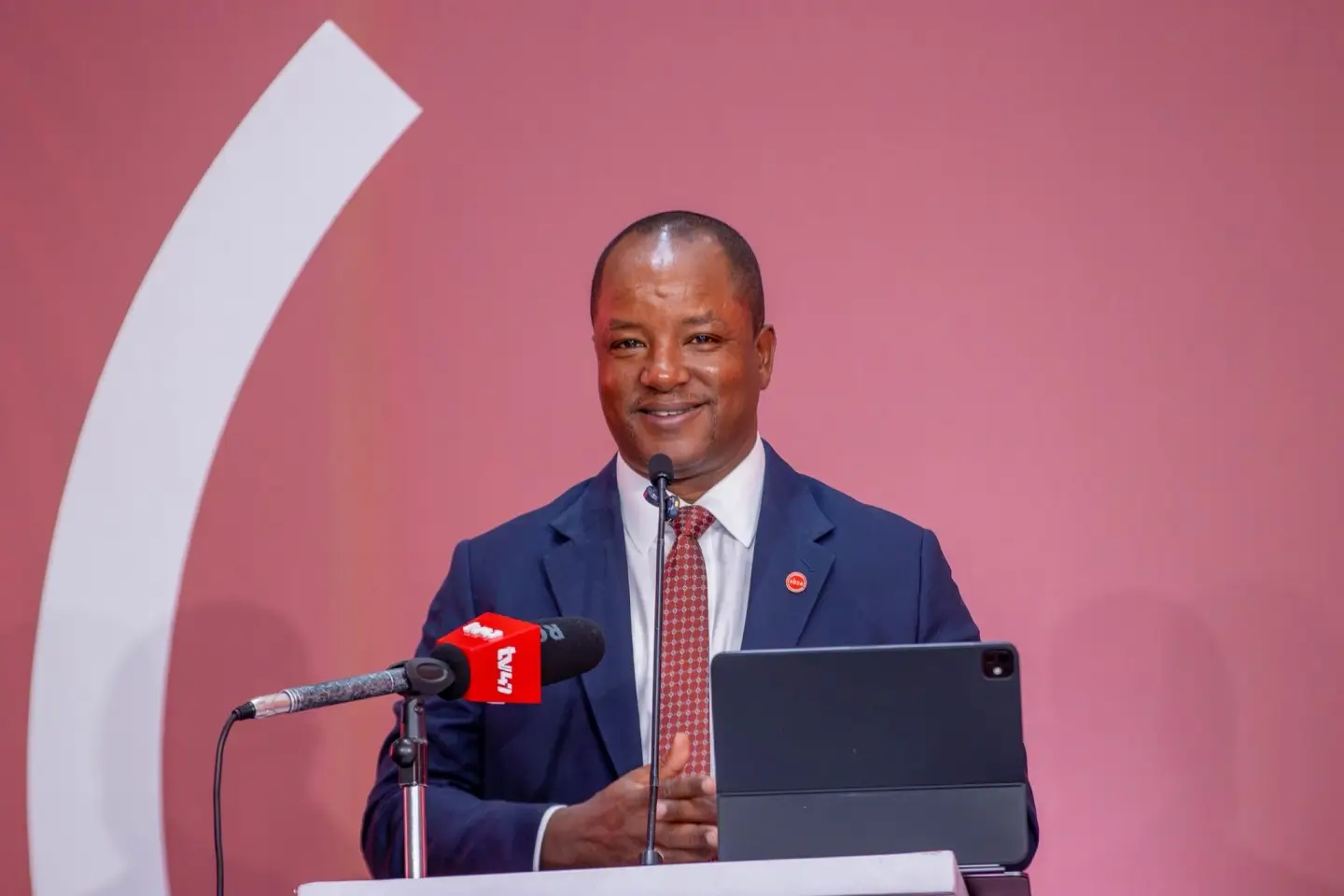
Absa Kenya H1 2026 results present an interesting contradiction. Profit after tax fell 10% to KSh10.5 billion as lower rates and weaker FX income weighed on revenue, yet the bank increased its interim dividend by 150% to KSh0.50 per share while continuing to expand several of the businesses it has identified as its next growth engines.
As the Central Bank of Kenya’s easing cycle compresses traditional lending margins, the institutions that come out ahead are the ones that had already begun building revenue engines beyond the loan book. Absa’s headline numbers reflect that impact with total income declining 7% to KSh29.3 billion and net interest income falling 5% to KSh21.1 billion. Non-funded income also declined 10% to KSh8.2 billion, largely due to lower foreign exchange income.
Profit before tax consequently fell 16% to KSh14.2 billion, while profit after tax declined 10% to KSh10.5 billion.The pressure on traditional banking income is not surprising in an easing rate environment. The Bank noted that the average lending rate had fallen to 14.3% from 17.2% in November 2024
Despite the red on the P&L, three areas stood out: digital banking, where digital revenue grew 34% and disbursements grew 17%; non-bank financial services, where bancassurance penetration jumped to 22% from 15%, and asset management and custody AUMs grew 40% and 19% respectively.
Also read: Absa Bank Kenya Posts 10% Profit Growth and Raises Dividend for FY2025
Non-Bank Financial Services: Bancassurance, Asset Management and Custody Businesses
Absa Kenya’s non-bank financial services are now pulling serious weight. Absa’s new-business income, spanning bancassurance, asset management, custody and related fee lines, grew 20% year-on-year to KES 2.92 billion, while non-funded income excluding FX and trading rose 9% to KES 5.34 billion.
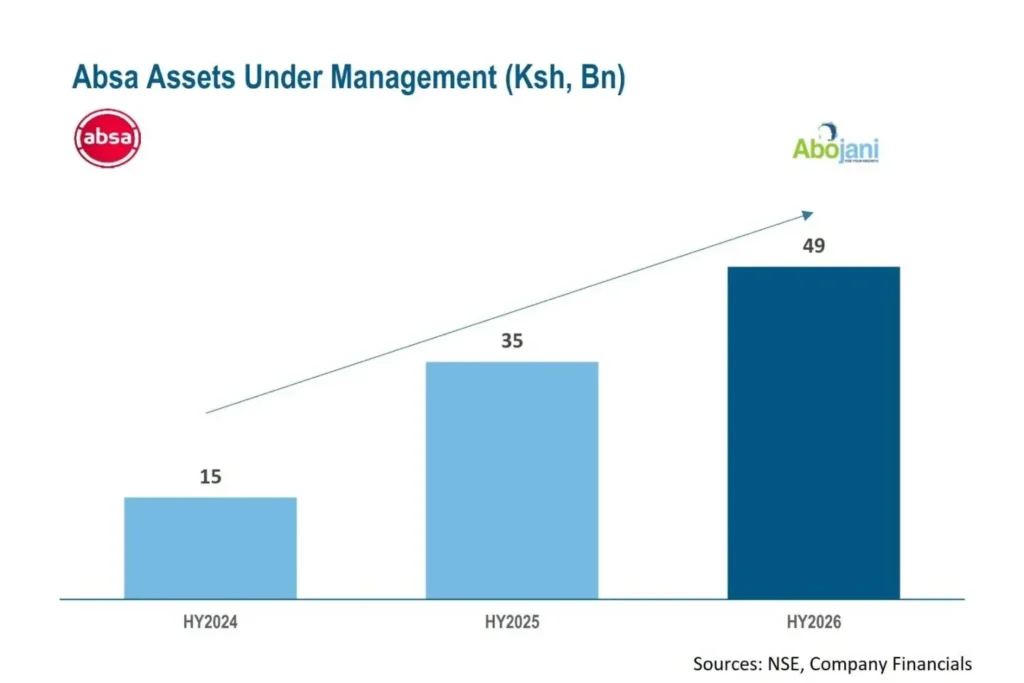
Bancassurance penetration increased to 22% from 15% at December 2025, a jump of seven percentage points in roughly six months. On the investment services side, assets under management in Asset Management reached KES 49 billion, an impressive 40% year-on-year, while Custody assets under management grew 19% to KES 67 billion.
These investments are part of the bank’s revenue diversification strategy and are intended to future-proof the business.
Management also noted that its asset management arm received Capital Markets Authority approval for new special funds during the period. A China Desk proposition, aimed at supporting corridor-led fee income from trade and investment flows between Kenya and China, was also highlighted as a contributor to this diversification push.
Digital Banking: The Clearest Growth Line in the Business
Digital revenue rose 34% year-on-year to KES 1.12 billion, while digital disbursements grew 17% to KES 14.8 billion. The bank reports that 68% of its Personal and Business Banking customers, and 71% of its Corporate and Investment Bank clients, are now digitally active, reflecting a multi-year push to shift transactional volume away from branch and agent networks and onto proprietary platforms.
That shift is also reshaping the bank’s cost base in ways that matter for long-term efficiency. Back-end workflow digitization and automation reached 71% in H1 2026, up from 62% year on year and just 47% in H1 2024, a trajectory that has freed up an estimated 24,372 staff manhours.
Absa’s non-funded income to operating expense ratio stood at 67.7%, and the frontline-to-support staff ratio has shifted to 68:32 in favour of customer-facing roles, evidence that automation is being used to redeploy headcount toward growth functions rather than simply cut costs.
Strategically, the bank is leaning further into embedded and partner-led distribution. Its Timiza lending platform continues to receive sustained investment aimed at onboarding merchants into partner ecosystems, alongside enhancements to merchant collections capabilities for SME customers.
Customer satisfaction on digital platforms was reported at 76%, alongside a Best Retail Bank Kenya 2026 award and a fifth consecutive Top Employer certification, showing that the digital transformation is translating into measurable customer experience gains beyond internal efficiency.
Global Markets
Global Markets was the exception to the broader diversification story. While non-funded income excluding FX and trading grew 9% to KSh5.34 billion, overall non-funded income declined 10% to KSh8.2 billion, with management attributing the pressure largely to weaker FX income as margins compressed.
In other words, the bank’s core transactional and advisory fee businesses expanded; it was the FX and trading desk, more exposed to global rate and currency volatility, that dragged the segment lower.
The Fuller Picture
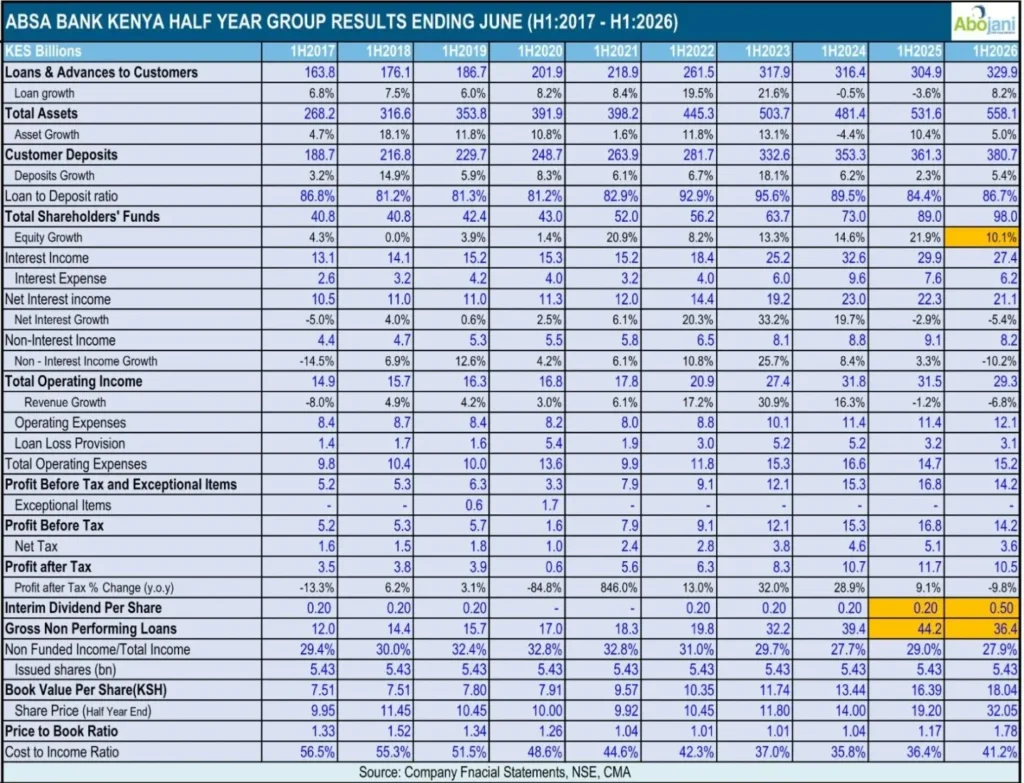
Zooming out to Absa’s H1 2026 balance sheet, customer loans and advances grew 8% year-on-year to KES 330 billion, with a notable 9% sequential jump between Q1 and Q2 2026 alone. Customer deposits rose 5% to KES 381 billion, and the bank made deliberate progress on funding cost discipline: current and savings account balances now make up 75% of the deposit book, up from 68% in H1 2025, helping push the cost of funds down from 3.7% to 2.8%.
Asset quality improved meaningfully. The gross non-performing loan ratio fell from 13.0% to 10.1%, comfortably below the industry average of 14.6% as at July 2026, while coverage strengthened to 69% from 67%. The loan loss ratio eased to 1.9% from 2.1%.
Operating costs rose 5.7% to KES 12.1 billion reflecting continued investment in the operating model redesign (KES 720 million, with a payback period of under two years) and digital capabilities (KES 749 million). That investment pushed the cost-to-income ratio up to 41.2%, a trade-off management has framed as deliberate: near-term efficiency given up in exchange for the digital and talent capacity now showing up in the growth lines.
A bigger reward for shareholders
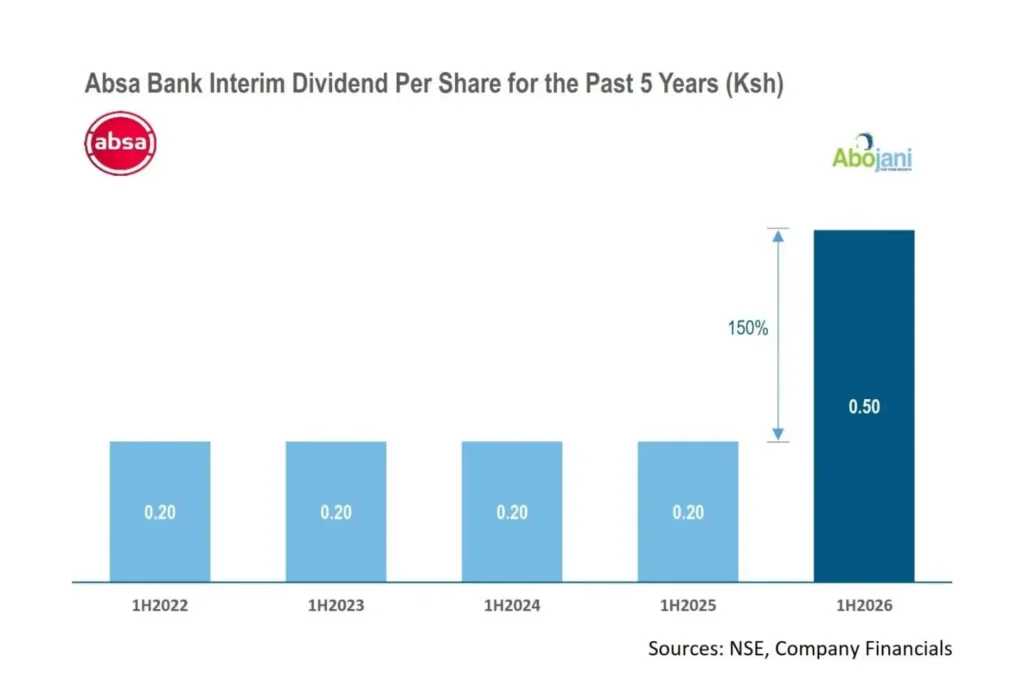
Perhaps the clearest vote of confidence in the bank’s longer-term trajectory came from the Board itself. Absa Kenya’s Board approved an interim dividend of KES 0.5 per share, a 150% increase on the previous year’s interim payout, payable on or about 15 October 2026 to shareholders on record as of 18 September 2026.
The bank has the balance-sheet capacity to support that payout. Its core capital ratio stood at 17.4%, comfortably above the 10.5% regulatory minimum, while liquidity stood at 42.7%, more than twice the 20% regulatory requirement. Return on equity remained strong at 21.7%.
Shareholders are also looking at a bank whose parent company has signalled confidence in the Kenyan business. Absa Group launched a voluntary tender offer to increase its stake in Absa Bank Kenya from 68.5% to as much as 85%, at KSh34.50 per share, while retaining the bank’s NSE listing, brand, Board and management.
Absa Kenya’s H1 2026 results reflect a bank navigating a tougher rate environment, with income and profit under pressure. But beneath the headline numbers, digital revenue is accelerating, new-business income is growing, bancassurance penetration is rising, and asset management and custody are expanding. With customer assets growing, funding costs improving and credit quality strengthening, Absa heads into the second half of 2026 with a stronger and increasingly diversified business.
#AbsaKenya
#YourStoryMatters
#Absa Kenya H1 2026 Results

CEO & Co-Founder, Abojani Investment
Robert Ochieng is a visionary entrepreneur and the co-founder of Abojani Investment, a leading financial education platform in Kenya that has empowered over 20,000 Africans to embark on their investment journeys. As CEO, he has demonstrated an unwavering commitment to financial literacy, successfully demystifying money and investments and making them accessible and relevant to individuals from all walks of life.
Running Thriving Investment Communities
Robert’s influence extends well beyond Abojani Investment’s core offerings. He has actively fostered a sense of community by running investment forums and groups with a vast following of over 300,000 Africans. These communities provide a safe space for individuals to exchange ideas, share experiences, and support each other on their investment journeys.
Vision for the Future
As co-founder of Abojani Investment, Robert envisions a financially empowered Africa. He strives to expand the reach of his financial education initiatives, enabling millions more to gain the knowledge and confidence needed to achieve their financial goals. His vision is to create a society where every individual has the tools and understanding to build lasting wealth and prosperity.
Professional Background
Robert Ochieng is a highly accomplished CEO at the helm of Abojani Investment, an investment and advisory firm in Kenya. He is a seasoned professional with over 14 years of experience in IT, Finance, and leadership.
His career includes key roles at prominent institutions such as Equity Bank, Gulf African Bank, Guaranty Trust Bank (GTBank) and Airtel.
Robert’s expertise has also been sought after by the National Treasury for consultancy on planning and budgeting systems, showcasing his exceptional knowledge and skills in the field. Passionate about driving meaningful conversations and collaborations between academia, industry, and the public sector, Robert actively engages in research projects focusing on digital transformation within the financial services sector. With his visionary leadership and strategic insights, Robert Ochieng continues to make a significant impact in the business world.