
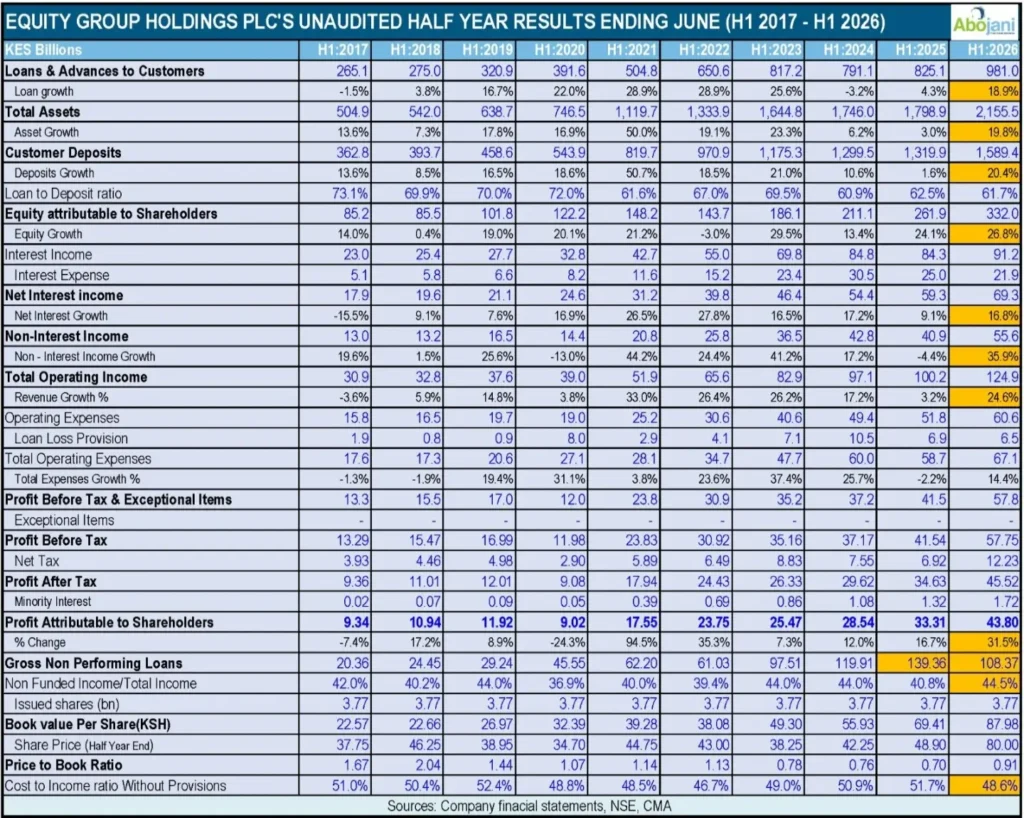
Equity Group Holdings Plc has delivered one of the stronger performances of the H1 2026 banking season, with profit after tax rising 32% year-on-year to KSh45.5 billion as stronger balance sheet growth, regional subsidiaries and rising non-funded income lifted the Group’s earnings.
Total income increased 25% to KSh124.9 billion, while non-funded income rose 36% to KSh55.6 billion and now accounts for 44.5% of total income, up from 40.8% in H1 2025. At the same time, the balance sheet expanded 20% to KSh2.16 trillion, with customer deposits growing 21% to KSh1.59 trillion and net loans increasing 19% to KSh981 billion.
Equity is growing its core banking business while simultaneously increasing the contribution from payments, insurance, regional operations and other non-funded revenue streams. The result is that it’s becoming increasingly diversified across both geography and business lines.
Also read: Equity Group Q1 2026: Profit Growth of 24% as Balance Sheet Crosses KSh 2 Trillion Mark
Equity Kenya’s recovery
One of the most significant developments in the results is the continued recovery of Equity Bank Kenya.
Profit after tax at the Kenyan banking subsidiary increased 32% to KSh25.7 billion, while its balance sheet expanded 13%. Deposits grew by an impressive 24%, although loan growth was more measured at 8%.
Equity Bank Kenya recorded 11% quarter-on-quarter loan growth in Q2 2026, marking the first time since Q3 2021 that quarterly loan growth reached double digits.
The bank also maintained its position in the MSME market. Between January and March 2026, Equity Bank Kenya accounted for 36% of the KSh101 billion in MSME loans issued in Kenya, reinforcing its role in a segment that remains central to the Group’s growth strategy.
The Regional Franchise
If Kenya’s recovery is one part of the H1 story, the other is the growing weight of Equity’s regional operations.
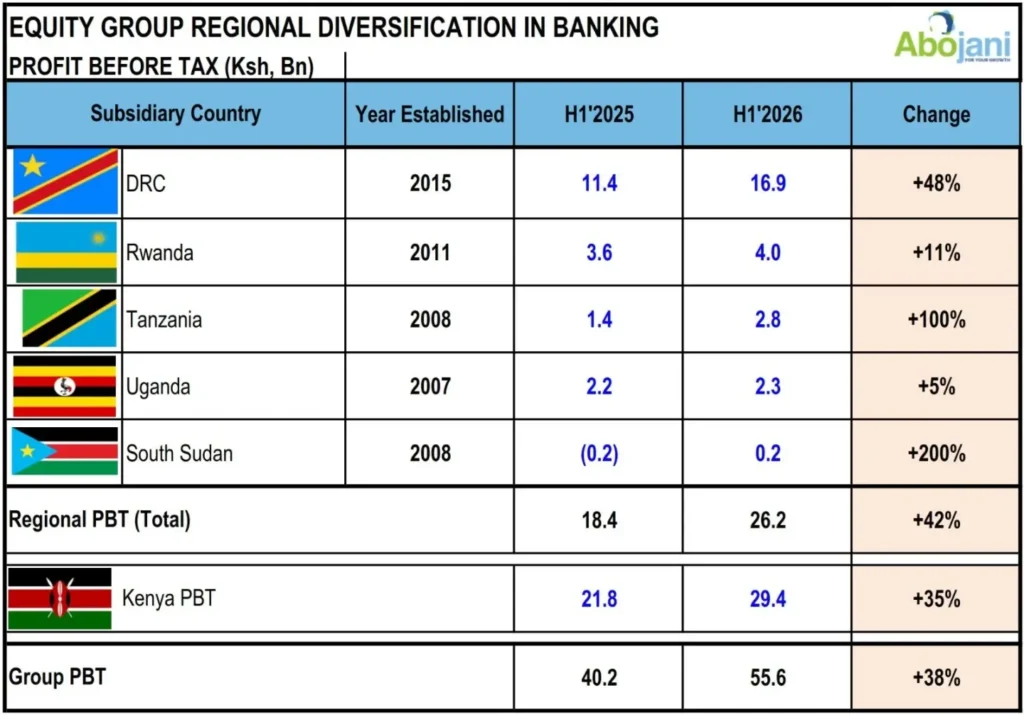
Regional banking subsidiaries now account for 42% of Group banking profitability and 47% of banking revenue. They also hold 51% of deposits, 54% of loans and 52% of banking assets, meaning that more than half of Equity’s banking balance sheet is now outside its home market.
The individual performances underline the momentum.
Profit before tax increased 30% to KSh22.5 billion, while its balance sheet expanded to KSh661.9 billion. Non-funded income rose 53% to KSh16.9 billion, making the DRC business increasingly important not only for the size of its balance sheet, but also for the diversity of its earnings. Equity BCDC is increasingly leaping toward a head-to-head race with Equity Kenya.
Equity Tanzania delivered an even sharper 82% increase to KSh2.0 billion. Rwanda’s profit after tax increased 12% to KSh2.9 billion.
The regional business also continues to expand its balance sheet. Across the regional subsidiaries, deposits grew 29% year-on-year and loans increased 30%, compared with 24% deposit growth and 8% loan growth in Equity Bank Kenya.
This is becoming one of Equity’s defining characteristics. The Group is no longer simply a Kenyan bank with operations elsewhere. Its regional businesses are becoming substantial contributors to earnings, deposits and lending, providing geographic diversification while giving the Group exposure to some of Africa’s faster-growing markets.
Non-funded Income Changing the Earnings Mix
Another important feature of the results is the continued rise of non-funded income.
Non-funded income increased 36% to KSh55.6 billion, compared with 17% growth in net interest income to KSh69.3 billion. As a result, non-funded income’s contribution to total income climbed to 44.5%.
With interest rates falling, lending margins can come under pressure. Fees, payments, foreign exchange, trade finance, insurance and other businesses provide additional sources of income that can continue growing even when the traditional lending business faces a tougher environment.
The Group’s non-banking businesses are also becoming more meaningful. Insurance, financial services and other non-banking subsidiaries contributed 4.8% of Group revenue, up from 4.0% YoY, while their contribution to profit before tax increased to 4.2% from 3.8%.
Insurance is particularly notable. Equity Insurance Group grew gross written premiums 24% to KSh6.4 billion, while profit before tax increased 34% to KSh1.25 billion. Insurance revenue across the Group rose 21% to KSh8.0 billion, while total assets increased 19%.
The scale of the customer base is perhaps even more telling. Equity’s life insurance business had issued 22.6 million policies to 7.2 million unique customers by June 2026, with more than 79% of policies distributed digitally.
The Group is also building out its general and health insurance businesses, giving it three insurance platforms covering life, general and health. The health business, which began operations in September 2025, recorded KSh1.87 billion in gross written premiums in H1 2026.
Digital Transformation is now visible in the numbers
In the technology Group, technology-enabled lending generated KSh5.7 billion in revenue in H1 2026, up 21%, with non-funded income rising from KSh2.3 billion to KSh3.4 billion. Lending transaction volumes increased 7% to 3.0 million, showing how technology is allowing Equity to serve customers at scale. 98.3% of transactions now take place outside branches, with 89.7% processed through digital channels.
Transaction volumes through digital channels continue to rise, while Equity is shifting activity away from fixed-cost channels such as branches and toward self-service platforms. The Group says this transition is helping support productivity and reduce the cost of serving customers.
The technology investment is also extending into artificial intelligence. More than 80% of staff have completed business-focused generative AI training, while hundreds have been admitted to advanced programmes in financial engineering and applied AI.
Equity is building shared technology infrastructure across its markets, including common data systems, APIs, payment rails and AI models that can be deployed across subsidiaries. The strategy is intended to make it easier to onboard customers, improve risk assessment, personalize products and reduce the cost of serving customers across the Group.
Group Asset Quality
Perhaps just as important as the speed of growth is the improvement in its quality.
Equity’s non-performing loan ratio fell from 13.7% to 9.5%, bringing NPLs back into single digits. NPL coverage also improved from 68% to 70%, while the cost of risk declined from 1.7% to 1.4%.
At the same time, the Group’s cost-to-income ratio improved to 48.6% from 51.7%, indicating that revenue growth is translating into stronger operating efficiency.
The combination of stronger earnings, better asset quality and improving efficiency helped push return on equity to 26.5%, reinforcing Equity’s position among the region’s more profitable banking groups.
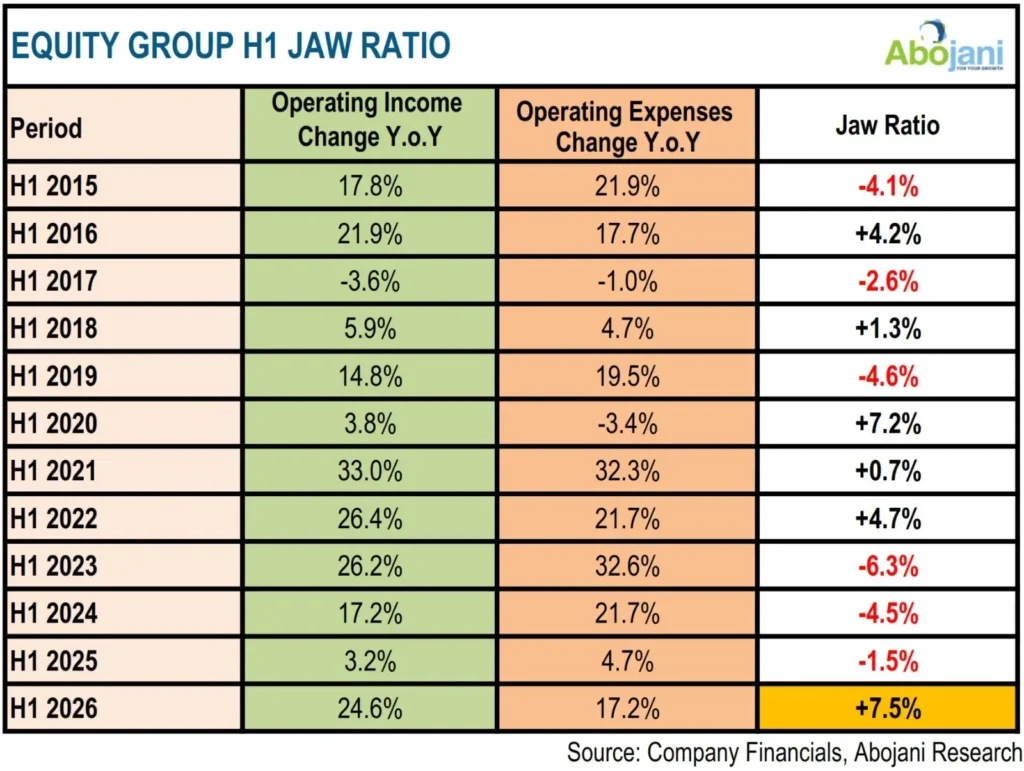
The H1 2026 results are ultimately a reflection of a transformation that has been underway for several years.
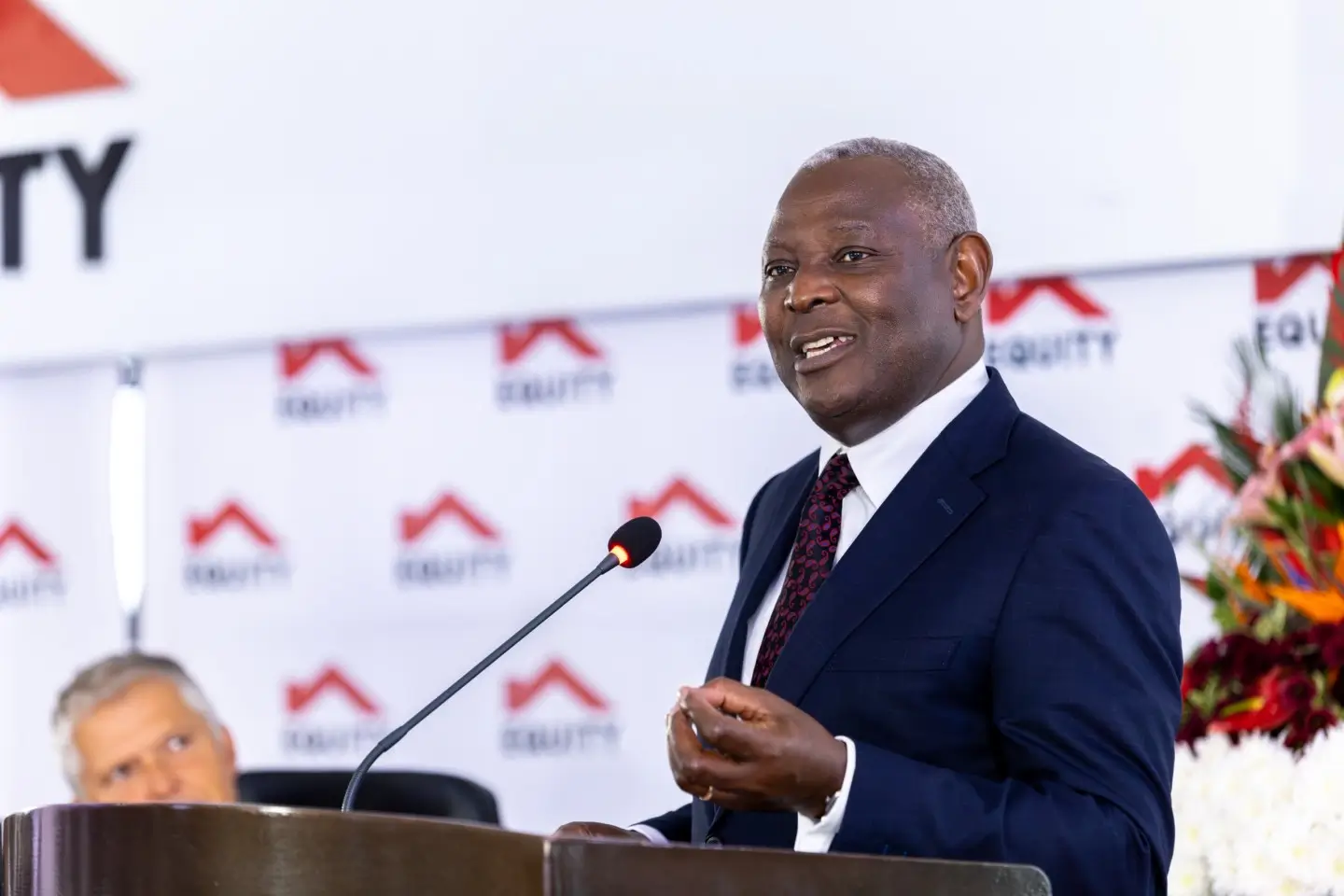
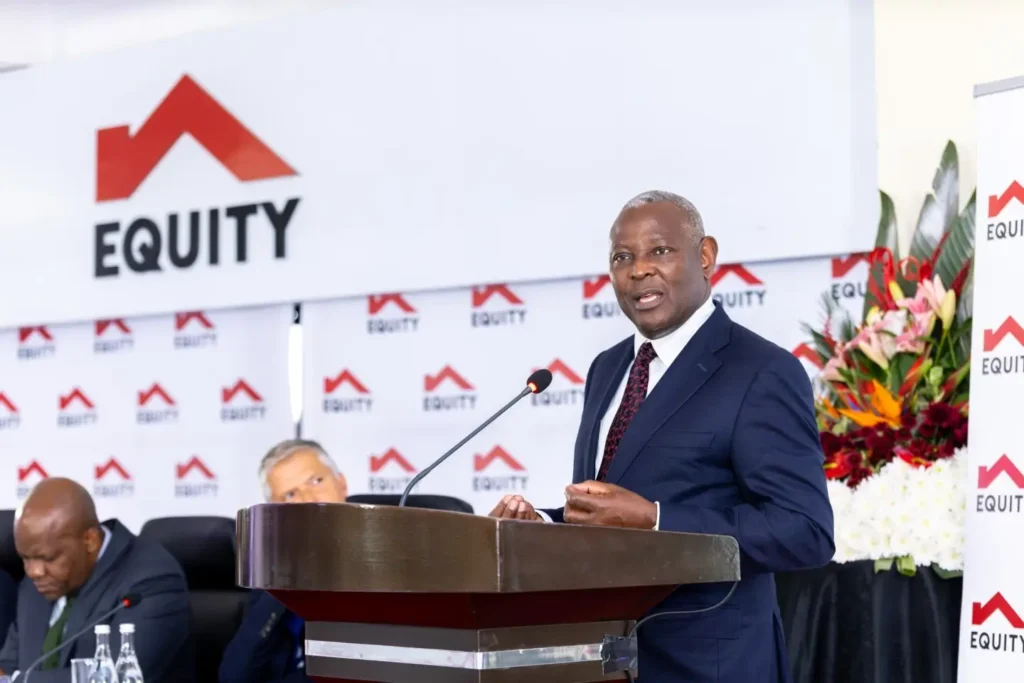
In the words of the Group’s Managing Director, Dr. James Mwangi:
“Our H1 2026 performance reflects the success of our deliberate transformation into a diversified, regional, technology enabled financial services Group. We are building a future ready institution; scalable, secure, and impact led, anchored in digital capabilities, staff upskilling, and a culture of disciplined execution. As we progress towards our Africa Recovery and Resilience Plan (ARRP) 2030 ambitions, we are evolving beyond traditional banking into an integrated tech enabled financial institution that mobilizes capital, connects ecosystems, and accelerates inclusive, sustainable prosperity across Africa.”
Under its ARRP 2030, Equity is targeting expansion into 15 countries and 100 million customers, supported by next-generation digital and AI-enabled systems. The next phase of Equity Group is worth betting on.
#Equity2026HYResults #Equity Group Holding

CEO & Co-Founder, Abojani Investment
Robert Ochieng is a visionary entrepreneur and the co-founder of Abojani Investment, a leading financial education platform in Kenya that has empowered over 20,000 Africans to embark on their investment journeys. As CEO, he has demonstrated an unwavering commitment to financial literacy, successfully demystifying money and investments and making them accessible and relevant to individuals from all walks of life.
Running Thriving Investment Communities
Robert’s influence extends well beyond Abojani Investment’s core offerings. He has actively fostered a sense of community by running investment forums and groups with a vast following of over 300,000 Africans. These communities provide a safe space for individuals to exchange ideas, share experiences, and support each other on their investment journeys.
Vision for the Future
As co-founder of Abojani Investment, Robert envisions a financially empowered Africa. He strives to expand the reach of his financial education initiatives, enabling millions more to gain the knowledge and confidence needed to achieve their financial goals. His vision is to create a society where every individual has the tools and understanding to build lasting wealth and prosperity.
Professional Background
Robert Ochieng is a highly accomplished CEO at the helm of Abojani Investment, an investment and advisory firm in Kenya. He is a seasoned professional with over 14 years of experience in IT, Finance, and leadership.
His career includes key roles at prominent institutions such as Equity Bank, Gulf African Bank, Guaranty Trust Bank (GTBank) and Airtel.
Robert’s expertise has also been sought after by the National Treasury for consultancy on planning and budgeting systems, showcasing his exceptional knowledge and skills in the field. Passionate about driving meaningful conversations and collaborations between academia, industry, and the public sector, Robert actively engages in research projects focusing on digital transformation within the financial services sector. With his visionary leadership and strategic insights, Robert Ochieng continues to make a significant impact in the business world.